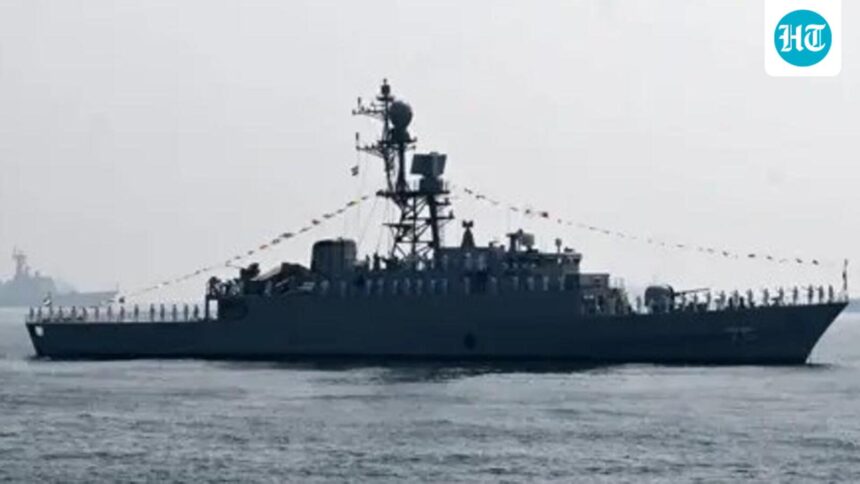
India granted permission to three Iranian warships to dock in the country’s ports three days before one of them, the IRIS Dena, was sunk by a US submarine near Sri Lanka, according to information provided by the government in Parliament on Monday.

Iran requested permission for the three warships, which were in territorial waters, to dock in India on February 28, the day Israel and the United States launched their attacks on Iran, and permission was granted the next day, March 1.
The Iranian frigate IRIS Dena was torpedoed and sunk by a US submarine near the coast of Sri Lanka early on March 4, killing nearly 90 crew members. The Sri Lankan authorities rescued 32 other crew members.
External Affairs Minister S Jaishankar gave details about the incident while making a statement on the rising tensions in West Asia in the Houses of Parliament. He added that the Indian government’s decision to allow one of the three Iranian warships, the Iris Lavan, to dock in Kochi was “the right thing to do.”
Read also: ‘Dialogue and diplomacy’ necessary to calm tensions in West Asia: Jaishankar in Rajya Sabha
“The Iranian side… requested permission on February 28 for three ships in the region to dock at our ports. This was granted on March 1,” he said in identical remarks in Rajya Sabha and Lok Sabha. “The IRIS Lavan has already docked on March 4 in Kochi.”
The IRIS Lavan crew is currently stationed at Indian naval installations. “We believe this is the right thing to do,” Jaishankar said, and the Iranian Foreign Minister expressed his country’s thanks for this humanitarian gesture.
Following the sinking of the Iris Dina, the Sri Lankan government allowed a second Iranian warship, the Iris Bushehr, to take shelter in its waters on March 6. The ship was later transferred to Trincomalee port and its 204 crew were accommodated at a marine facility.
Earlier, while participating in the Raisina Dialogue on Saturday, Jaishankar said the Indian side received a message from Iran that “one of the ships, which was supposedly the closest to our waters at that time, wanted to enter our port.”
“It took a few days to sail and the ship docked in Kochi and the ship was there,” he said, referring to IRIS Lavan. “These ships…were coming to review the fleet and then somehow stumbled on the wrong side of events…Among the other ships, one ship had clearly encountered a similar situation in Sri Lanka and made the decision they did. Unfortunately one did not make the decision.”
The three Iranian warships were in Indian waters to participate in an international fleet review and multi-nation exercise conducted last month. Only IRIS Dena officially participated in these events while the other two remained in Indian waters and participated in other engagements. For example, IRIS Lavan and IRIS Booshehr visited the Mumbai port in late February and interacted with the Indian Navy.
The Iranian Navy also requested permission, before the outbreak of hostilities, for the three warships to enter Kochi port to refuel before returning home, people familiar with the matter said, on condition of anonymity.
It was not immediately clear why IRIS Dena and IRIS Booshehr did not seek shelter in an Indian port after permission was granted on March 1, the people said. They pointed out that Sri Lanka invited IRIS Dena to make a port call and that is why it sailed towards the neighboring country.
The sinking of the Iris Dina marked an expansion of the Iran-US conflict into India’s strategic backyard at a time of growing concerns about the economic fallout of the war, especially for energy supplies from West Asia.