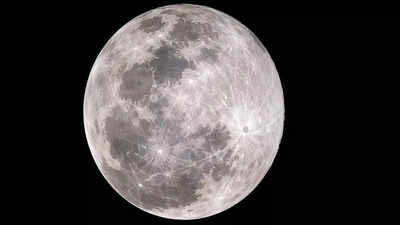
The Moon has been our closest companion for billions of years, influencing the tides, stabilizing our planet’s axis, and regulating natural cycles. But if they suddenly disappeared, how would it affect our planet? The latest scientific study reveals that if it suddenly disappeared, it would have a profound impact on our planet.Recent studies have shown that the moon is constantly changing. The study, conducted using data collected by NASA missions, revealed that the moon is constantly shrinking as it cools internally. The study was conducted by researchers at the Center for Earth and Planetary Studies at the National Air and Space Museum.The researchers focused their study on the cracks and slopes on the moon’s surface. It was based on previous research conducted by Thomas R.
Watters, a senior scientist emeritus at the Center for Earth and Planetary Studies.
What would happen if the moon disappeared?
Scientists often study hypothetical scenarios to understand how important the Moon is to Earth’s stability. If it disappeared, many systems on Earth would change.The Moon plays an important role in multiple Earth systems. If this is absent, processes related to tides, planetary stability, and certain biological cycles could change dramatically.
How the moon is slowly shrinking
The Moon is slowly shrinking due to the cooling and contraction of its interior. This happens when the moon loses heat from the inside. This results in the formation of slopes known as lobate slopes on the Moon’s surface. This causes the moon to contract and thus shrink.These cliffs were observed using images of the Moon from the Lunar Reconnaissance Orbiter spacecraft sent back by NASA.It documented research conducted by scientists at the National Air and Space Museum’s Center for Earth and Planetary Studies, including work led by Thomas R. Watters identified these features and linked them to the Moon’s gradual cooling process.
How does the moon affect the earth?
The moon plays an important role in the nature of various natural events. The most prominent of these events is ocean tides. Its gravitational force makes the oceans on the Earth’s surface move toward the Moon. Ocean movement causes tides. The disappearance of the moon does not mean the disappearance of tides completely, but rather the tides will be only a third of their total strength.The Moon is also responsible for keeping the Earth’s axis at a constant tilt. The tilt of the Earth’s axis is about 23.5 degrees. This is responsible for the seasons. The disappearance may cause the Earth’s axis to tilt significantly. This can cause unexpected changes in the weather, as well as the seasons.The gravitational interaction between the Earth and the Moon is responsible for slowing down the Earth’s rotation. It is believed that in early times, the Earth’s day was only about 8 to 10 hours long. The Moon’s gravitational interaction with the Earth is thought to have slowed the Earth’s rotation to a 24-hour day-night cycle.The results highlight the Moon’s role in shaping many physical processes on Earth. Studying the Moon and its evolution helps scientists better understand the long-term interactions between Earth and its natural moon.
A stunning celestial display: The moon turns crimson as a rare blood moon lights up the night sky