

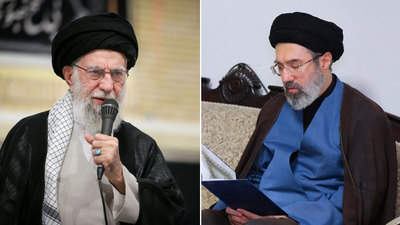
The appointment of Mojtaba Khamenei as the new Supreme Leader of Iran comes at a moment when the Islamic Republic is witnessing extraordinary turmoil. The announcement was made shortly after midnight on Monday by Iran’s powerful Assembly of Experts, the clerical body responsible for choosing the country’s supreme leader, following the death of his father, Ayatollah Ali Khamenei, in US-Israeli airstrikes earlier this month.The leadership change comes amid an intensifying regional war that broke out after the strikes that killed Khamenei, the senior leader.
Iran’s great boldness as Trump warns that ‘new supreme leader will not last’; Tehran responds details
With Iran under intense military pressure and facing mounting internal uncertainty, the assembly’s decision signals an attempt to ensure continuity at the top of the political and religious hierarchy.
A quiet personality who has long been viewed as a power broker
Mojtaba Khamenei, long seen as a potential successor despite not holding any official government position, emerged as the chosen candidate over other contenders including cleric Ali Reza Arfi, hardliner Mohsen Araki and Hassan Khomeini, grandson of the founder of the Iranian revolution.
Mojtaba Khamenei was born on September 8, 1969 in the city of Mashhad in northeastern Iran, a major religious center. He is one of six children of Ayatollah Ali Khamenei, who served as Iran’s supreme leader for more than three decades.Although he rarely appeared prominently in public life, Mojtaba gradually built his influence within the political and religious establishment. His discreet presence at official events and limited media exposure has fueled speculation for years about the extent of his power behind the scenes.
The 56-year-old is now the second supreme leader chosen by the Assembly of Experts since the 1979 Islamic Revolution.
Religious training and advancement within religious circles in Iran
Mojtaba Khamenei studied Islamic theology in the holy city of Qom, the most important center for Shiite religious studies in Iran. He later taught religious studies there and attained the religious rank of Hujjat al-Islam, a mid-level title below the rank of Ayatollah held by his father.His religious status, along with his family lineage as a master—a descendant of the Prophet Muhammad—played a role in enhancing his religious credentials within Iran’s religious establishment.
His relations with the Revolutionary Guard and the conservative establishment
Mojtaba Khamenei has long been seen as closely linked to Iran’s powerful security services, especially the Islamic Revolutionary Guard Corps. His connection to the force is said to date back to the final years of the Iran-Iraq War in the 1980s, when he served in a combat unit.Over time, analysts and diplomats noted that he built strong relationships with conservative factions and the security establishment, giving him influence within the country’s political power structure even without holding an official position.
When the United States imposed sanctions on Mojtaba
The United States imposed sanctions on Mojtaba Khamenei in 2019, accusing him of representing his father in political affairs and working with Iranian security forces to promote regional and local government policies.Opponents inside Iran also accused him of playing a role in suppressing the protests that broke out after the re-election of hardline President Mahmoud Ahmadinejad in 2009, although these allegations have not been officially confirmed.Investigations by international media also claimed that Mojtaba Khamenei amassed significant wealth through complex financial networks linked to oil revenues and foreign investments.The selection of Mojtaba Khamenei represents a rare hereditary shift at the head of the Iranian political system. The Islamic Revolution of 1979 overthrew the monarchy and ended centuries of dynastic rule under the Shah.Despite this history, the Assembly of Experts ultimately chose the son of the late Supreme Leader, prioritizing continuity during a period of war and political uncertainty.Israel has already issued warnings to the new Iranian leadership, a sign that the regional conflict is far from over with Mojtaba Khamenei assuming the most powerful position in the country.