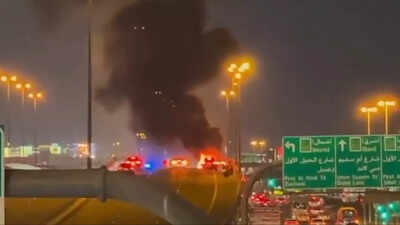
Falling missile debris kills a driver in the Al Barsha area of Dubai, amid the war between Iran, the United States, and Israel
Dubai authorities have confirmed that a Pakistani driver died after debris from an air interceptor fell on his car in the Al Barsha area, marking one of the most tragic civilian accidents linked to the escalating regional conflict between Iran, the United States, and Israel.The deadly incident occurred when UAE air defense systems intercepted missiles and drones, as part of a broader wave of attacks across the Gulf region. Officials stressed that the driver’s death was not caused by a direct hit but by fragments from a destroyed shell falling in the air, highlighting the unpredictable dangers posed by modern air warfare, even when defense systems succeed in neutralizing threats.
Major Iranian drone attack: Fire and smoke seen from Dubai’s historic Marina Tower; Evacuations are underway
This event received widespread attention around the world
United Arab Emirates
At the international level, which highlights the extent of geopolitical tensions in the region
The Middle East
It increasingly affects daily life in cities far from the front lines.
What happened in Al Barsha?
According to the Dubai Media Office, debris from a shell destroyed during an air interception fell on a vehicle that was traveling in the Al Barsha area, a major residential and commercial area in western Dubai. Debris hit the car and led to the death of the driver, who was identified as a Pakistani national.
Emergency teams, including Dubai Police and Civil Defense teams, quickly arrived at the scene to secure the area and assess the damage. The authorities opened an investigation and offered condolences to the victim’s family. Officials said the incident occurred during active air defense operations in response to missile and drone threats targeting the UAE. The loud explosions heard in several parts of Dubai that evening were related to the interception operation and not to direct impacts.
A second incident in Dubai Marina
The Al Barsha tragedy occurred around the same time as another incident in Dubai Marina, where debris from the same intercept hit the facade of a residential skyscraper. While the tower sustained minor external damage, authorities confirmed that no injuries were reported at that location.
The building incident quickly spread on social media after videos showed smoke billowing from the high-rise building, sparking speculation before officials clarified that it was caused by falling debris and not a direct attack. Together, the two events demonstrated the unexpected impact of air interceptions in densely populated urban areas.
The broader conflict between Iran, the United States and Israel is behind the incident
The Dubai incidents come amid an escalating conflict involving Iran, the United States and Israel, which has led to missile and drone attacks across the Middle East. The conflict intensified after joint US and Israeli strikes on Iran, prompting Iran to respond with waves of missiles and drones that targeted US military bases and strategic infrastructure in the region.Many Gulf countries, including the United Arab Emirates, Kingdom of Saudi ArabiaSince then, Qatar and Bahrain have activated air defense systems to intercept incoming threats. According to official data, hundreds of missiles and drones have been launched towards the UAE since the conflict escalated, and the vast majority of them were intercepted before reaching their intended targets.
However, even successful interceptions can produce falling debris, creating secondary risks to civilians.
Why do missile interceptions still carry risks?
Modern air defense systems are designed to destroy incoming threats before they reach their targets. Interceptor missiles hit enemy drones or ballistic missiles in the air, causing them to explode and disintegrate. While this process prevents catastrophic damage to the ground, it also produces fragments of metal, fuel tanks and electronic components that can fall to the ground.Military experts say the exact landing site of the debris depends on factors such as:
- High interception
- Wind direction and speed
- The size of the destroyed projectile
- Distance from target area
In densely populated cities like Dubai, even small fragments can cause injuries, property damage, or, in rare cases, fatal accidents. The case of Al Barsha illustrates how these fragments can travel far from the original point of interception before falling to Earth.
UAE air defense response amid war between Iran, the United States and Israel
The UAE has deployed one of the most advanced air defense networks in the region, which includes radar detection systems, interceptor missiles, and fighter aircraft. When incoming threats are detected, the defense system activates a multi-layered response that includes:
- Early warning radar detection
- Track missiles or drones
- Launching interceptor missiles to destroy them in the air
- Deploy fighter aircraft to intercept air threats
Officials say that these systems have successfully intercepted most incoming projectiles during the current crisis, preventing potentially serious damage to infrastructure and residential areas. However, authorities acknowledged that falling debris remained an unavoidable hazard during interceptions.
Public safety alerts in the UAE and emergency measures amid the war between Iran, the United States and Israel
During the recent wave of missile and drone threats, UAE authorities issued several public safety alerts through portable warning systems. Residents in multiple areas received messages advising them to stay home or seek temporary shelter during interceptions.These alerts are part of the country’s broader emergency preparedness strategy, which includes:
- Emergency rapid response teams
- Civil defense coordination
Airspace monitoring
- Temporary flight disruptions if necessary
Dubai International Airport briefly suspended operations earlier in the conflict before gradually resuming flights once the immediate threat subsided.
The impact of the Al Barsha accident on residents and expatriate communities
The death of the Pakistani driver had a strong resonance with expatriate communities across the UAE. Foreign nationals make up the majority of the country’s population, and many residents have expressed shock that the regional conflict could lead to a fatal accident within Dubai, a city widely viewed as one of the safest urban centers in the Middle East.
Community leaders and diplomatic officials called for support for the victim’s family while emphasizing the importance of public safety during periods of heightened security activity. The Al Barsha incident is part of a broader pattern of attacks and interceptions occurring across the Gulf during the ongoing conflict.Missile alerts and drone interceptions have been reported in several countries that host US military bases, including:
- Qatar
- Kingdom of Saudi Arabia
- Bahrain
- Kuwait
Analysts warn that if the conflict continues to escalate, the Gulf states could face persistent missile and drone threats, making air defense operations a regular part of regional security.
What will happen next in the UAE amid the war between Iran, the United States and Israel?
Currently, UAE authorities say the situation remains under control and that the country’s defense systems are fully operational. Officials continue to monitor the regional situation while urging residents to rely on official announcements rather than unverified social media reports during recent incidents. Minya.At the same time, the Al Barsha tragedy served as a sobering reminder that even cities far from combat zones can suffer the indirect consequences of modern warfare. As tensions continue in the region, governments across the Gulf will likely work to strengthen defense coordination, expand early warning systems and maintain high security preparedness to protect civilian populations.