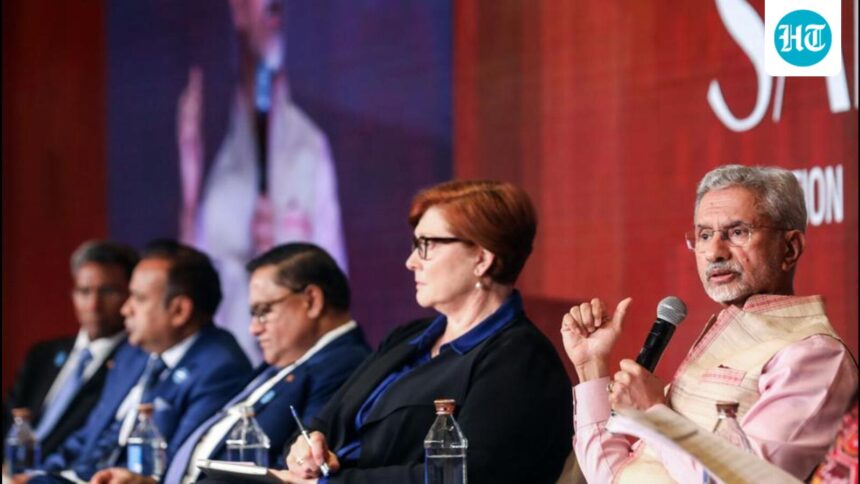
India and many of its neighbors in the Indian Ocean on Saturday supported regional frameworks to ensure maritime security and respect for international laws, following the sinking of an Iranian warship by the United States. The Minister of Foreign Affairs, S. Jaishankar stressed that India remains a net security provider to the region.

Jaishankar joined his counterparts from Sri Lanka, Mauritius and Seychelles to stress the importance of international laws, especially UNCLOS, in dealing with recent developments and ensuring unimpeded freedom of navigation and trade at the Raisina Dialogue session that focused on the future of the Indian Ocean.
The sinking of the Iranian frigate Iris Dina by a US submarine near the coast of Sri Lanka on March 4 has raised concerns about the West Asian conflict expanding into India’s strategic backyard. The Iranian warship was departing after participating in an international fleet review and a multi-nation exercise hosted by India. Since then, two other Iranian warships have been docked in Sri Lanka and India, and their crews have been sheltered ashore.
Read also: India will plan its own rise, Jaishankar responds to the US official’s statements
Jaishankar, the first senior Indian leader to comment on the sinking of the Iris Dina, said that India received a message from the Iranian side on February 28 that one of its ships wanted to enter an Indian port after encountering problems. Permission was granted on 1 March, and the warship IRIS Lavan docked in Kochi on 4 March. IRIS Lavan staff, including several young students, are based at a nearby facility.
“When these ships set off and came here, the situation was completely different. They were coming to review the fleet and then they were caught on the wrong side of events,” Jaishankar said.
“For us, when this ship wanted to enter and was also facing difficulties, this was a humanitarian act,” he said, referring to the sinking of the IRIS Dena. “We were guided by this principle. Among other ships, one of the ships faced a similar situation in Sri Lanka and made the decision it did. Unfortunately, one did not make the decision.”
“We approached it from a humanitarian point of view, as opposed to whatever the legal issues were. I think we did the right thing.”
In a carefully considered response, Jaishankar insisted that India remains a “net security provider” in the Indian Ocean, a region where outside powers like the US and China maintain a military presence in places like Diego Garcia, Bahrain and Djibouti.
He said: “We are a net security provider, but that does not replace or negate the facts of what the region is, because it is a region in which countries other than the countries of the region are present in a maritime manner.”
Read also: Iranian Deputy Foreign Minister: The sinking of the “unarmed” ship Iris Dina cannot go unpunished
He added: “Diego Garcia has been in the Indian Ocean for the past five decades… and the fact that there are foreign forces stationed in Djibouti occurred in the early 2000s. Hambantota emerged during this period… and the US Fifth Fleet is stationed in Bahrain.”
Sri Lankan Foreign Minister Vijitha Herath, responding to the sinking of the Iris Dena and reporting US pressure not to return the warship’s crew members, stressed the importance of following UNCLOS and international laws. “Sri Lanka faces a lot of challenges… We need to strengthen it [the] “Implementing international laws,” he said.
“In this incident also…we are following international laws and have taken all steps in accordance with international laws. I believe we do not need any party’s support. We have taken all steps in a humanitarian manner,” Herath added.
Herath, Mauritian Foreign Minister Dhananjay Ramphole and Seychelles Foreign Minister Barry Faure stressed the importance of regional cooperation frameworks to ensure maritime security and uphold international laws. Jaishankar said India is practicing what it preaches by asking all countries to abide by the provisions under UNCLOS.
Jaishankar also highlighted India’s focus on ensuring the safety of Indian seafarers and 10 million Indian citizens living in West Asian countries amid conflicts. “Indians constitute a very large segment of the people who operate commercial ships. Every time there is an attack on a tanker or ships carrying goods, it is very likely that all or part of that ship will be piloted by Indians,” he added, referring to the Indian deaths in the recent attacks on two oil tankers.