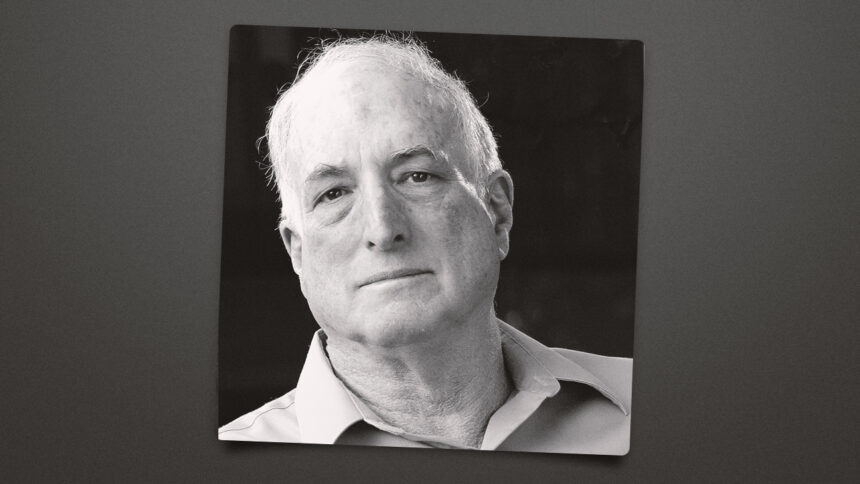
Jeremy Larner, whose experience as a speechwriter for 1968 presidential candidate Eugene McCarthy informed the screenplay for his Oscar-winning film starring Robert Redford. CandidateHe died. He was 88 years old.
Larner had been ill for some time and died on February 24 at a nursing home in Oakland, California, his son, Jesse Larner, said. Hollywood Reporter.
For the only screenplay produced, Larner adapted his 1964 novel Lead, he saidfor the gritty 1971 basketball-focused film of the same name that marked Jack Nicholson’s directorial debut.
Larner joined McCarthy on the campaign trail in March 1968, as the Minnesota senator was running on a platform of ending U.S. involvement in the Vietnam War, in an attempt to secure the Democratic nomination for president.
McCarthy appeared poised to win, but after President Lyndon Johnson withdrew from the race and fellow nominee Robert Kennedy was assassinated, the nomination went to Vice President Hubert Humphrey.
After writing Nobody Knows: Reflections on the McCarthy Campaign of 1968a book that gained traction when it was serialized in Harper Magazine in 1969, Redford and director Michael Ritchie approached Larner to write the script for it Candidate (1972).
In the Warner Bros. film, Redford plays idealistic young liberal Bill McKay, a poverty lawyer and son of a rolling governor (Melvyn Douglas) who is groomed by a political consultant (Peter Boyle) to run against incumbent Republican candidate Crocker Jarman (Don Porter) for California Senate.
McKay voices his opinion, believing he has no chance of winning – until he does, eventually leading him to ask Boyle’s Marvin Lucas, “What do we do now?”
Redford and Ritchie “had some ideas of what they wanted the movie to be, and the ending as well,” Larner recalled in a 2016 review. Brooklyn Magazine Interview with Steve MacFarlane about his work on the film. “One of the reasons they reached out to me was because I was one of the few writers who had written speeches for a presidential campaign, and a screenwriter at the time as well.
“That’s what I said the first time I met her [them]: You said, for me, a politician is like a movie star. He can lose himself in a character – this is true of many stars, and it was truer then – who is like himself, only larger than life, as a symbol of what is beautiful and what is real. I was aware, of course, that Redford was this kind of icon. As I said this, I said to myself: “Now you are definitely losing your job.”

“This is where my experience with McCarthy came in: I would write a speech, hear McCarthy deliver my words as part of his speech, and see the response he got from it. He would say things that would enable people to cheer themselves up by cheering him on.
“I thought campaigning was like drifting down the river on a raft, where everything is beautiful: then you start to hear the waterfalls roaring ahead, but it’s too late. Go over the falls, you lose yourself, and are forever confused by the difference between who you are and who your audience thinks you are. It’s a separatist and disarming experience. Redford played that very well: the better McKay gets on the campaign trail, the more he loses himself.”
Jeremy David Larner was born on March 20, 1937, and grew up in Indianapolis, where he won the city’s high school tennis championship while attending Shortridge High School. His father, Martin, was president of the Jewish Community Center Association.
Larner graduated from Brandeis University in 1958, where his fellow activists included soon-to-be Abbie Hoffman, and then entered the University of California at Berkeley for graduate work on a Woodrow Wilson Fellowship.
He moved to New York when he was 22 and remained there throughout the 1960s, working as a freelance journalist for publications such as life – Who covered the 1968 Mexico City Olympics – New Republic and Harper‘s.
Larner also authored two novels and three non-fiction books during this period, including… Poverty: Perspectives from the Left; Lead, he said; The addict is on the street; It is based around LSD The answer.
During the McCarthy campaign, Larner wrote a radio commercial for Paul Newman that ran in Indiana, and wrote a magazine article for the actor about why he liked the senator.
Larner Lead, he said The novel revolves around two Ohio University roommates, one a reclusive basketball star (played by William Tepper in the film) and the other a revolutionary (Michael Margotta). Its title is taken from a quote from a Robert Creeley poem I know a man.
In 1968, Nicholson phoned Larner and said, “Jerry, I’m going to be a star, and they’re going to let me direct a picture. I want you to come out and write it,” he said. Los Angeles Magazine In 1996. So Larner left Boston — and was working at Harvard at the time — to come to Los Angeles
Larner said he wrote the first draft of Lead, he said Then he rewrote Nicholson’s rewrite. (Also contributing to the screenplay: Terrence Malick and Robert Towne, both uncredited.)

By the time the R-rated film wrapped production — it was rejected at Cannes and ran in theaters for only weeks before being pulled — Nicholson was already a star. Easy Rider In his pocket, Larner had returned to Harvard before Candidate The opportunity arose.
“I came to New York,” he told MacFarlane. “Redford and Ritchie met with 10 different writers who had experience in political films, or had experience writing speeches. I thought I wouldn’t get the job, especially because I had long hair and a beard at the time[[He laughs]. But I thought I was free to say what I wanted to say, and I was surprised that they called me back.
“Then they came to Cambridge…and we worked mostly in my kitchen – I think we went out to dinner a few times. We worked out the nature of the story, and I told them stories of my experiences with McCarthy, some of which I put directly into the script. For example, the moment someone hands McCay a Coca-Cola and a hot dog, so that his hands are busy, and then hits him in the face – this actually happened to McCarthy!
To conduct further research, Larner spent a week with Democratic Senator John V. Tony, who was recently elected as a California state senator. One of Tony’s lines — “I have a confession: I ate all the shrimp” — made it into his script.
He was given a month to write the script, and Larner said it took him two weeks, working from noon to 3 a.m. every day, to come up with 180 pages. After that, he was on the $1.1 million set every day, constantly rewriting it.
“I’m a bit surprised that the ending was good – more than good. That line, ‘What do we do now?’, is probably not something a real politician would say,” he said. They think they know what they’re doing as a rule, even when they don’t!
On Oscar night in 1973, Larner thanked in his acceptance speech “the political figures of our time who have given me wonderful inspiration. I believe that as long as they continue to do the things they do and use the words they use, words like ‘honour,’ there will be better pictures and clearer pictures even of them.” Candidate“.
Larner went on to write approximately a dozen screenplays but had no other screen writing credit. “I got paid a lot better than them and I think some of them were a lot better than them Candidate“But I was never able to make any,” he said. These drafts included several drafts North Dallas Forte (1979) and adapted from Joseph Conrad’s novel victory By Sidney Pollack.
“I thought I was the exception to the rule as far as writers having influence, but writers don’t have any influence unless they become Paddy Chayefsky,” he said. Redford has given environmental speeches, spoken on college campuses and written Chicken On the Church and Other Poemspublished in 2006.
Survivors include his sons, Jesse and Zachary, and his brother, Daniel. He was married to Brandeis colleague Susan Berlin from 1960 until their divorce in 1968.
In his interview with MacFarlane, Larner said that while making the film CandidateMany people working on the film did not understand his script, and he noted that he was “constantly explaining myself.”
“It made sense for Redford and Ritchie, I always thought, but again I was always reminding them where the scenes fit together, and their concern was always making sure the scenes fit,” he recalls.
“But the idea for the film preceded the script. When Redford and Ritchie approached me, McKay was the son of a former governor, trapped in an uncomfortable situation, and surprised when he wins. Kind of like me when I won the Oscar.”