India on Thursday expressed its condolences over the killing of Iranian Supreme Leader Ali Khamenei in joint Israeli-US military strikes after remaining silent on the issue since the weekend, even as External Affairs Minister S Jaishankar spoke to his Iranian counterpart Syed Abbas Araqchi to discuss the evolving situation in West Asia. Track updates on the Iran-US conflict

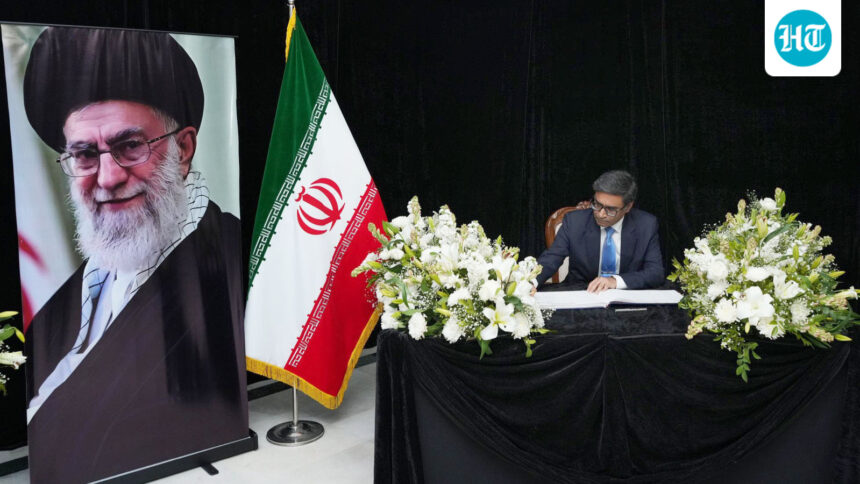
Foreign Minister Vikram Misri visited the Iranian embassy on Thursday afternoon and signed the book of condolences on behalf of the government. He also had a short interaction with Iranian Ambassador Mohammad Fatahli. Al-Masry wrote in his condolence book: “My sincere condolences on behalf of the government and people of India. We pray for peace for the departed soul.”
Also Read: New LG for Delhi; Bengal, Tamil Nadu and Bihar get new rulers in the key region
Jaishankar spoke with Araghchi by phone for the second time since February 28, when Israel and the United States launched military strikes on Iran. “I had a phone call with Iranian Foreign Minister Seyed Abbas Araqchi this afternoon,” Jaishankar said on social media, without providing details.
These developments came in the wake of sharp criticism from the opposition Congress Party and former military and diplomatic officials of India’s position on the killing of Khamenei and the sinking of an Iranian frigate inside Sri Lanka’s exclusive economic zone on Wednesday by a US submarine, while it was leaving the region after participating in an international fleet review and a multinational exercise hosted by India.
The Ministry of Foreign Affairs issued two statements on February 28 and March 3 to express concern about the situation in West Asia and to advance dialogue and diplomacy with the aim of finding an “early end” to the conflict. The ministry stressed India’s focus on the security of 10 million Indian citizens living in West Asia and on avoiding any major disruption to the trade and energy supply chains that pass through the region, but it remained silent about the killing of Khamenei and the sinking of the Iranian frigate Iris Dina.
After the death of then Iranian President Ebrahim Raisi and Foreign Minister Hossein Amir Abdollahian in a helicopter crash in May 2024, Jaishankar visited the Iranian embassy to express his condolences, while the foreign minister was handling India’s response to Khamenei’s death.
Congress leader Sonia Gandhi was among those who criticized the government’s stance on the killing of Iran’s supreme leader, saying its silence raises questions about the credibility of India’s foreign policy and will facilitate the erosion of international norms.
“When the targeted killing of a foreign leader calls for no clear defense of sovereignty or international law on the part of our country and neutrality is abandoned, it raises serious doubts about the direction and credibility of our foreign policy,” Gandhi wrote in an op-ed.
Former foreign ministers Nirupama Menon Rao and Kanwal Sibal questioned the government’s stance on the sinking of the Iranian frigate by a US submarine shortly after it participated in events hosted by India, while former Indian Navy chief Admiral Arun Prakash, one of the country’s leading commentators on security issues, described the US action as “condemnable” and an “inflammatory act”.
Sri Lankan officials said 32 crew members of the IRIS Dena were rescued, while 90 bodies were recovered after the warship sank.
In a social media post, Rao wondered whether the national interest was “always better served by saying nothing” and added: “India cannot aspire to be a voice of civilization and a chameleon of karma at the same time.”
Sibal asserted on social media that the United States “ignored India’s sensitivities” because the Iranian frigate was in “these waters due to India’s invitation.” He added: “We are far from political or military responsibility for the American attack. “Our responsibility” is [on] A moral and human level.”
Referring to the multi-nation exercise in which Iris Dina participated last month, Sibal said: “This US action violated the spirit of the Milan exercise in which the Iranian Navy participated in some way, especially because it took place not far from the Indian Maritime Ocean.”
Prakash said in a social media post that sinking the Iranian warship “with huge loss of life is a senseless and inflammatory act.” He added: “Initiating another dimension of violence in this open conflict will spread panic on the high seas and disrupt global seaborne trade.”
The Indian Navy said in a statement on Thursday that it “immediately launched” search and rescue efforts after the Maritime Rescue Coordination Center (MRCC) in Colombo received a distress call from IRIS Dena in the early hours of Wednesday. This included the deployment of a long-range maritime patrol aircraft and the warship INS Tarangini to bolster the Sri Lanka-led search effort.
Another Indian warship, INS Ikshak, also sailed from Kochi to enhance search efforts and remains in the area to search for the missing personnel as a humanitarian gesture, the statement said.
The sinking of the Iranian warship is seen in Indian circles as a widening of the scope of the Iran-US conflict, which has already affected the flow of energy supplies through the Strait of Hormuz. Iran responded to the Israeli and US strikes with a wave of attacks targeting Israel and US military bases in countries such as Bahrain, Kuwait, Jordan, Saudi Arabia and the United Arab Emirates.