

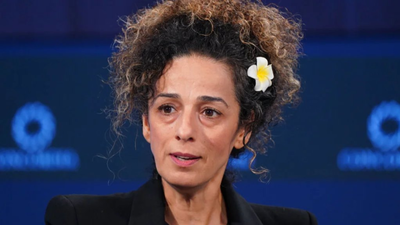
Masih Alinejad is back in the news after she posted an emotional video in response to the death of Iranian Supreme Leader Ali Khamenei. She said in a broken voice: “Finally, you have died, and finally you are gone, Ali Khamenei.”
In the same clip, she was seen hugging strangers in New York. For Alinejad, this embrace was not theatrical. It was, as I later explained, a business of survival.
In response to comments about “hugging strangers,” she wrote that when you live in exile and cannot safely hug your mother, strangers stop feeling like strangers. She said the people she embraced saw both joy and sadness on her face. “This is not performance.
This is survival.” She added that America saved her life three times and that the people around her became her new family. For Alinejad, developments in Iran are never abstract political events.
These are personal and intimate accounts. She wrote that when what she calls terrorism collapses, survivors do not mourn it. They are breathing. For many across Iran, Syria, Iraq and the broader Middle East, such moments represent accountability.
Born on September 11, 1976 in rural northern Iran, Alinejad began her career as a journalist in 2001, writing for reformist newspapers including Hambastiji and Shargh. As a parliamentary correspondent in Tehran, she covered corruption and misconduct among lawmakers, earning a reputation for targeted and confrontational reporting.After the disputed 2009 presidential election and the protests that followed, she left Iran.
She later studied communications at Oxford Brookes University and has lived in New York since 2009, becoming a US citizen in 2019.Alinejad is best known for her campaign against mandatory hijab laws in Iran. In 2014, she launched the My Stealthy Freedom project, inviting women to share photos of themselves without a hijab. The campaign attracted more than a million likes and evolved into related movements such as “White Wednesdays” and “Camera is my weapon.”
Through these initiatives, she turned social media into a form of civil resistance.She hosts “Tablet” on Voice of America’s Persian service, and has contributed to media outlets including IranWire, Radio Farda, and The New York Times. In 2021, she co-founded the World Freedom Congress. After Mahsa Amini’s death in 2022, she became one of the prominent voices in support of the Women, Life, Freedom movement. In January 2026, she addressed the United Nations and accused Iran of committing war crimes.Alinejad married Khambez Foruzandeh in 2014. Her memoir, The Wind in My Hair, published in 2018, became a bestseller. Over the years, she has received numerous honors, including the Geneva Summit Award in 2015, the Moral Courage Award in 2022, and recognition as Time Magazine’s Woman of the Year in 2023. The New York Times once described her as “the woman whose hair would intimidate Iran.”From her early days in Tehran to her life in exile in New York, Masih Alinejad has built a career defined by confrontation with authority and advocacy for women’s rights. For its supporters, it is a symbol of defiance. For the Iranian state, it remains an adversary abroad.