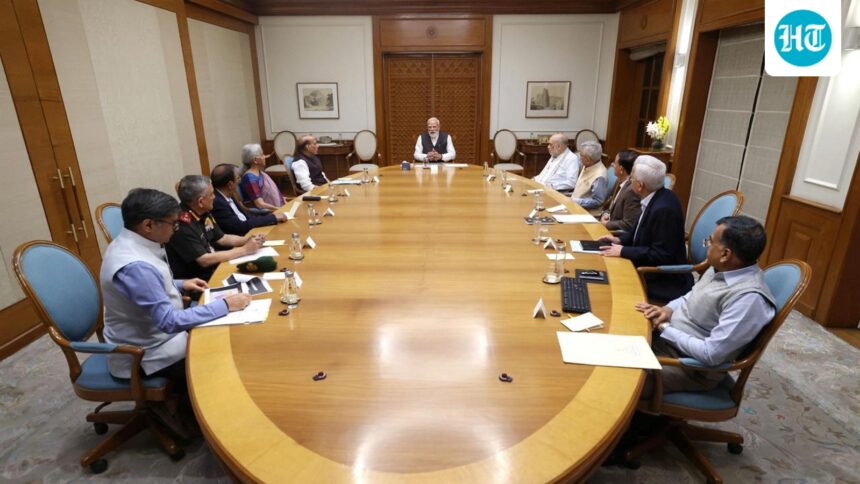
Prime Minister Narendra Modi on Sunday chaired a meeting of the Cabinet Committee on Security (CCS) to review the rapidly evolving situation in West Asia in the wake of the US-Israeli strikes on Iran and the growing regional escalation that followed. According to a statement from the Press Information Bureau (PIB), the Central Advisory Committee was briefed on the February 28 airstrikes in Iran and the subsequent escalation, including attacks in several Gulf states. The high-level committee expressed grave concern over the safety and security of the large Indian community across the region.

“CCS reviewed the difficulties faced by Indian travelers transiting the region and students attending scheduled examinations, as well as the broader ramifications on regional security, economic and trade activities. CCS directed all departments concerned to take necessary and feasible measures to assist Indian nationals affected by the developments. It stresses the importance of early cessation of hostilities and a return to dialogue and diplomacy,” PIB said in a statement.
India has an estimated 9.6 million citizens living and working in West Asia, including about 10,000 in Iran. With several countries closing airspace and missile and drone attacks in parts of the Gulf, New Delhi is closely monitoring the situation.
CCS reviewed the difficulties faced by Indian travelers passing through major Gulf hubs, with many of them stranded or diverted due to the suspension of flights. The committee also discussed the concerns of students due to sit for exams in affected countries, as well as the broader ramifications of the conflict on regional security, economic stability and commercial activities.
The committee ordered all relevant departments to take “necessary and feasible measures” to assist Indian citizens affected by the developments. But officials indicated that New Delhi is not immediately considering evacuations, given the closure of airspace in several countries and the turbulent security environment.
The meeting was held soon after Prime Minister Modi returned to Delhi late on Sunday night from a two-day visit to Tamil Nadu, where he inaugurated development projects in Madurai. This comes against the backdrop of India’s increasing diplomatic sensitivity.
Days before that, Modi traveled to Israel, where he addressed the Knesset and elevated bilateral relations to a special strategic partnership. The visit was marked by strong public messages of solidarity. However, the new conflict between Israel and Iran puts India in a delicate balancing act as it seeks to maintain strategic ties across the region while protecting its diaspora and economic interests.
The Ministry of External Affairs has already issued advisories urging Indian citizens in Iran, Israel, Jordan, Qatar, UAE and Palestine to exercise utmost caution, avoid non-essential travel and remain vigilant. The Indian embassies in Tehran, Tel Aviv, Abu Dhabi and Damascus have activated helplines and are in constant contact with citizens.
External Affairs Minister S Jaishankar spoke separately with his Iranian and Israeli counterparts, conveying India’s “deep concern” over the developments and reiterating the need for restraint. In its earlier statement, the Foreign Ministry said India believes that “dialogue and diplomacy must be continued to de-escalate tensions and address fundamental issues”, adding that the sovereignty and territorial integrity of all countries must be respected.
Reiterating this position, the Committee stressed the importance of an early cessation of hostilities and a return to dialogue.