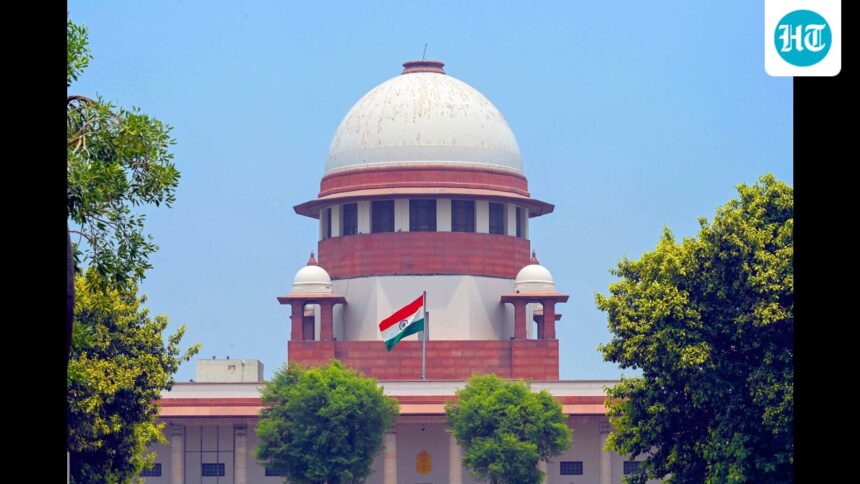
The country needs to create an enabling environment for private players to invest in its energy needs, the Supreme Court said on Friday, as it postponed hearing of a petition challenging provisions of the Sustainable Harnessing and Development of Nuclear Energy to Transform India (SHANTI) Act 2025, which puts an end to the liability of private players and the government in the event of a nuclear tragedy.

A bench of Chief Justice of India Surya Kant and Justice Joymalia Bagchi said: “As a nation, we need to create an environment where people can come forward. If damage is done, unfortunately, and the damage is assessable, the private institution will pay up to the limit set by law. The person who has suffered will not be able to seek compensation beyond that limit. The government may pay the remaining liability.”
The bench adjourned the hearing seeking time to read the public interest petition filed by former bureaucrat EAS Sarma and five others. “It is a sensitive issue. We would like to examine it first,” the council said, though it stressed that the issue also related to India’s energy security concerns.
“We have to balance clear and tangible national interest with identifiable compensation. The problem seems to be one of need and capacity. Coal is in short supply, we don’t have gas, forests are untouchable. Even to harness solar energy, we need lithium for which we have to go to our neighboring country (China). Where do we go,” the bench noted.
Power needs cannot trump public safety, advocate Prashant Bhushan, representing the petitioners, said the provisions of the Shanti Act limit the liability of a private operator to what amounts to a low level. $100 crores and up to the remaining liabilities to be incurred by the government up to a maximum of $300 million (approx $3000 Crores).
“The exemption from operator liability in the Shanti Act would encourage manufacturers and suppliers to follow safety measures in order to maximize their profits, thereby risking putting people’s lives and livelihood at risk,” Bhushan said. He added that this is more serious because operators under the Shanti Law of 2025 can now be private and foreign profit-driven companies.
He referred to the Chernobyl nuclear disaster in 1986 in the former Soviet Union, where losses were estimated at between $235 billion and $700 billion, and the 2011 Fukushima Daiichi nuclear power plant accident in Japan, where damages were estimated at $400 to $445 billion.
“In contrast, the Shanti Act 2025 caps the liability of India’s largest terminal operator at merely $“Rs 3,000 crore represents less than 0.1% of the damage cost of Chernobyl or Fukushima accidents,” Bhushan said.
“What our energy basket should be is a political decision taken by the government. In this petition, we need to know whether the 2025 law is clearly unfair or arbitrary in fixing the liability cap. We will see,” the bench said.
The petition also highlighted the “conflict of interest” inherent in the law whereby the Atomic Energy Regulatory Board (AERB), which is responsible for regulatory functions, is placed under the control of the government when it comes to selecting, appointing and removing the Chairman and members of the Board.
This contravenes India’s international obligation under the Nuclear Safety Convention, which India ratified in 2005. The agreement requires a concrete separation of the functions of the regulatory body, she added.
The authority said it would like to know about regulations in other countries and wondered whether the petitioner had conducted such an analysis. “We need to know whether there is any comparable jurisdiction on this issue. We live in a global village and regulatory regimes should be comparable,” the bench said.
Bhushan said the law also gives the central government the power to exempt nuclear power plants from the provisions of the Right to Information (RTI) Act, 2005. It also exempts the operator from any liability in case of damage caused by a natural disaster. This violates the principles of “strict liability” and “polluter pays” that have evolved under Supreme Court rulings, the petition said.