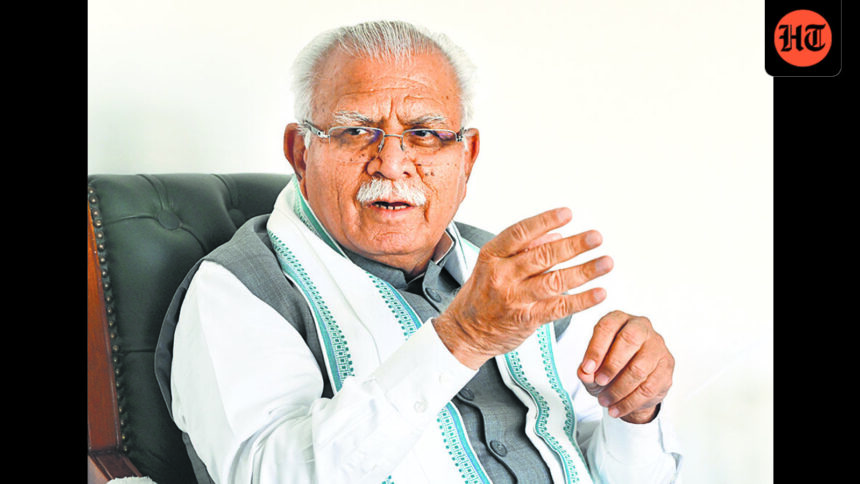
Urban local bodies that are actively developing their own resources should be moved to the top of the queue to get financial assistance from the Union and state governments, said Manohar Lal Khattar, Minister of Housing and Urban Affairs. In an interview with Hizb ut Tahrir, he warned against the trend towards providing free public services and stressed the need to build the capacity of urban local bodies to generate revenue to pay their share of centrally sponsored schemes and contribute to recently approved projects. $1 lakh crore Urban Challenge Fund. He also clarified that his ministry will not hesitate to refuse approvals for metro projects that do not make financial sense. Edited excerpts:

The Federal Cabinet recently approved $1 lakh crore Urban Challenge Fund, under which states have to contribute 25%, and 50% has to come from financial institutions. Given the financial constraints faced by urban local bodies, how many cities will be able to implement bankable projects in the next year or two?
Although announced in last year’s Budget, long-term plans – especially five-year plans – require significant planning and approval time, including from the Prime Minister’s Office. All planning has now been completed, and a nominal amount will be allocated this year to start the programme, to be fully implemented next year.
Major projects will focus on a revenue generation model to ensure repayment, so that investments in these projects can be realized. For example, integrated command and control centers can use private household identifiers to track and increase property tax collections through digitization. The 50% cost of increased revenues is easily paid back within four to five years. Other examples include parking sites, local markets with rental income, and toll roads. This model ensures the participation of urban local bodies (ULBs), states and the Centre.
Projects funded solely by the central government often fail due to lack of maintenance and ownership; Therefore, I believe that these projects under the Urban Challenge Fund will be very successful. And so all projects $4 crore will be a success
What will be the role of special players? Would they be interested in projects for the greater good?
Projects are being built by both the government and the private sector today. Financing can include bonds, banks and non-banking financial institutions (NBFCs). Public-private partnership projects will continue to attract private sector players.
Profit is determined during the tender process. The contractor includes its profits in the one-time cost regardless of the revenue model. For services such as sewerage and water, ULBs must implement user fees to ensure that the money can be paid back over a long period, such as 10 to 20 years. Financing can be done through banking and non-banking financial companies. Whoever gets the contract will make a profit; It may be more or less. In the end, it is the first-tier bidder (lowest bidder) that will receive the contract.
The budget for major projects like AMRUT and Swachh Bharat Abhiyan (aimed at improving the quality of life in urban areas) has come down from last year. Fund use has been low compared to estimates in recent years. Could there be a design change to improve the use of funds?
They are centrally sponsored contribution schemes in which funding is shared between the Center and the states. Spending depends on countries’ responses and speed of implementation. Budgets are estimates based on previous years’ actual spending. We update the technology periodically and focus on building the capacity of ULBs, as they sometimes lack the capacity to spend available funds.
Challenges include a shortage of qualified contractors or sole bidders (for contracts) leading to re-bidding, land acquisition obstacles, and difficulties in project visualization. We provide guidance and support through official visits to resolve these issues at the state and local levels. I also did a couple of tours of visits around the country. Primarily, this (performance) depends on the states and ULBs and less on us.
Increasingly, the focus is shifting to improving the “own source revenues” of ULBs. Do they have the ability?
We must encourage them and help them. Governments cannot finance everything as public expectations rise. There is a trend towards demanding free services. Then one looks at the amount of money coming from the center and the state. ULBs, as the third tier of government, must augment their own resources under the provisions of the Seventy-Fourth Amendment. But they will implement it only when it becomes a condition for obtaining financial assistance. It should go to those who are actively working to build their own resources.
Would you suggest stopping the freebie trend?
We have to stop this. Even the courts help us. In a recent case, the court questioned the advertisement of free electricity in Tamil Nadu and asked the source of funding for such advertisements. Even though you will be providing it for free (to people), you will still need to pay for it. Where will you get the money from? This is cause for concern. As part of good governance, we all need to think about this.
Indore, often held up as a model city in terms of civic governance, has recently had deaths linked to contaminated drinking water reported. How could such a serious threat to public health go undetected?
Issues such as water and sanitation are primarily the responsibility of the municipality and the state. Although the incident is tragic and the investigation is still ongoing, it occurred in a backward area of the city where (civil) work is still pending.
While we have no direct role in this matter, we have directed local agencies, there and across the country, to replace old water lines.
The Urban Challenge Fund is also prioritizing the redevelopment of these older neighborhoods. For example, in Delhi’s Gilurwala Bagh, slum clusters of 2,000 houses have been replaced by multi-storey apartments, which were inaugurated by the Prime Minister. It takes time to solve problems in centuries-old cities, and although the incidents are unfortunate, they remain a serious concern.
The results of the National Peyjal Survekshan Water Quality Survey (2022-2023) have not been fully published. Will the ministry conduct such a survey in the future, and will its results be made public, as is the case with the national Swachh Survekshan rankings?
Swachh Survekshan rankings are made public to inspire and create awareness among citizens. However, water surveys involve internal engineering work and municipal operations. Publicizing internal shortcomings may weaken officials’ morale. These surveys are intended to serve as internal tools to alert municipalities about what needs to be corrected. Even if the survey is conducted, the results will not be made public, but will only be shared with the authorities.
What is the status of Delhi Master Plan and National Capital Regional Plan?
The draft Delhi Master Plan is ready and is in the final review stages between our administration and the Union Home Ministry. We are confident that during the next two meetings between the Ministry we will be able to finalize this. The NCR Master Plan has been delayed due to court decisions, and Aravalli (issues related to the region), but many issues have been resolved now. The DDA Chairman is now in charge of the NCR Planning Board, and a meeting will be held Meeting soon to finalize it.
What about the scheme to grant property rights to residents of Delhi’s unauthorized colonies (launched in 2019)? It also recently announced that Delhi’s slums will be redeveloped soon. Can you give us the details?
Delhi’s development has suffered due to past friction between the Center and the state, as it is a UT and cannot function without the support of the central government. We now have a three-engine government (BJP in power in downtown Delhi, Municipal Corporation of Delhi). Through better coordination, we are implementing PM-UDAY to grant land rights to residents of 1,700 colonies. Although the law was passed in 2019, the previous government did not implement it properly. But we are fast tracking it. Not only will we settle these colonies, we will also give them rights to the land so they can be redeveloped. We will announce the policy soon.
Regarding slums, the plan is to replace them with housing or apartments in their natural location within a distance of 3 kilometers. We will keep some shares and give the rest to the residents. The ministry and the Delhi government have made budgetary allocations. The policy will be announced soon.
We also started moving slum residents into unoccupied government homes. More than 700 families from a large settlement that used to live on Race Course Road (Lok Kalyan Marg) have already been allotted houses.
Why is the uptake of affordable rental housing not seeing traction under the Pradhan Mantri Awas Yojana (PMAY 2.0)?
Affordable rental housing (ARH) was introduced to assist the moving population. The first model involves converting vacant government houses, while the second model encourages private projects with government assistance. PMAY 2.0 focuses specifically on ARH, but currently, states and the private sector are evaluating how to implement the projects. So far, only the states of Tamil Nadu, Haryana, Rajasthan and Gujarat have started adopting it. Often, implementing these schemes takes a long time as countries try to figure out how best to mobilize resources.
In Delhi, we are rehabilitating nearly 40,000 vacant homes to make them habitable for rent. Those that cannot be repaired will be demolished, and the land will be used to build new affordable homes.
Recently, there was a controversy over the rejection of the Coimbatore Metro Rail project.
The data submitted by Tamil Nadu for Coimbatore was found to be inconsistent by the approval committee. There were expectations of numbers (number of passengers) even higher than those in Chennai. We have to see what the ridership is and what the revenue can be. While a one-time capital loss can be managed through loans, recurring losses will be more difficult to manage. They are conducting a new survey.
Population figures available are from the 2011 census. Everything else is the projected population. The new census numbers will be available by 2027. If the new numbers are useful (for Coimbatore Metro), it will get approval. I have invited the Chief Minister of Tamil Nadu for a meeting to discuss this matter.
There are smaller cities that don’t have as much demand, but they have the metro. How viable are those?
There may be one or two of these cities, because things are done according to expectations. Also, one line is not applicable. The number of passengers increases only when the network has two or three lines. As is the case with Delhi.
But people in these small towns travel shorter distances…
Many cities see the metro as a sign of progress; It is a prestigious project. But they must be told that this approach will lead to losses.
But in cities with metros, the focus is on creating networks. But we’ll go for shorter lines. Often, there is an emphasis on connecting the metro to the airport, but only a small portion of the population (in these cities) goes to the airport. The priority should be to connect the city market with high traffic and industrial areas via the metro.
So whatever experience we gain is taken into close consideration while considering new projects. If there is no financial feasibility we will not hesitate to refuse it (approvals).