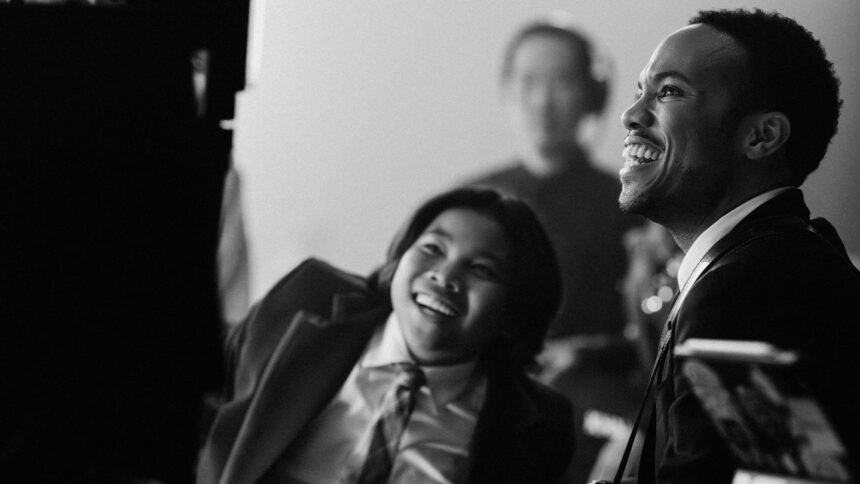
During the pandemic, Grammy Award-winning musician Anderson Paak was looking for a way to connect with his son’s two obsessions at the time: YouTube videos and K-pop. “He was about eight years old, and [I didn’t know] “About any of that stuff,” Buck says Hollywood Reporter.
So he began to draw on his own experiences – and Kpop!his directorial debut was born. The film, which stars Pak, who is Korean, alongside his real-life son Sol Rashid, has been five years in the making. He plays BJ, a down-on-his-luck musician who travels to Seoul to join a popular K-pop competition series, where he joins a group of trainees led by Rasheed’s character, Tae-young – who turns out to be BJ’s son.
“It could be something that highlights black culture, Korean culture, and a family comedy that everyone can watch,” Pak says of his vision for the film, which opens today (February 27) in AMC theaters nationwide.
It’s a busy moment for Paak. On top of the release, he’s gearing up to hit the road with his longtime friend and collaborator Bruno Mars, performing as DJ Pee .Wee on the singer’s latest tour. The two make up the duo Silk Sonic and have won four Grammy Awards together.
“I hope we can make more music too while we’re together,” he spoke of their plans for the tour. “I know your schedule is going to be very busy, but shoot man, I think we can definitely get this done.”
Buck talked to THR About making Kpop!Why the story matters to him and what Korean and black music history have in common.
How did you start Kpop!?
I knew I was going to need some experience on set, so I had the opportunity to at least direct a bunch of videos, so I could have a video to show people. When I think about the whole process, man, even just getting to the point of shooting the movie – it took years and it’s what it is [just coming out] now. I remember how sensitive we were to everything, with Korean things, black things, and then with my son. He’s gotten older and gone from loving K-Pop to when we were shooting, and now he loves Slipknot. Now I say, “Okay, let me figure it out.” He’s also going through puberty on set, so some of the things we wrote for this eight-year-old wouldn’t be appropriate for an 11-year-old. We only get a certain amount of time with him before he goes back to being a kid again. Being a father on set, there were a lot of different things that I discovered about myself, that I discovered about my child, and it was just… I got my ass kicked, but I would do it again in a heartbeat. I can’t wait to do it again.
It’s very funny to think about how children’s interests change over time. How was your journey with K-Pop?
A lot of it stems from my desire for approval and my desire to be kind to my child and my family. When he was little, my eldest son was always the one to look after my new music. I’ll play it for him, and if he likes it I’ll choose it. He was my biggest fan. Then suddenly, my whole house was like, “No, we’re K-Pop now. We love BTS.” It was just this invasion in the house. I was like the odd man looking in.
I grew up in a black family, black culture. I didn’t know anything about my Korean side. My mother was adopted from Korea in the 1950s and is half Korean, but she didn’t grow up with that at home. She had black adoptive parents, and that’s how she was raised. But I was introduced back to Korean heritage through my son’s mother and brought into this whole world.

I touched on it earlier as well, but what makes the film, in my opinion, so interesting is bringing different cultures into the fold. Especially considering how black culture and black artists have greatly influenced K-pop.
I’ve had a lot of unique experiences with both, and I know a lot of people have, but there aren’t a lot of movies that showcase that. I felt like this was a great opportunity because when he was showing me this stuff, like with K-Pop, I said, “Okay. You know about K-Pop, what do you know about Tupac?” [You] Do you know about BTS, what do you know about BET?” I was always trying to make sure there was balance.
Also, when I was looking at it at face value, it immediately made me think of groups I came up with like New Edition, TLC, SWV and then even Motown. How they had an assembly line, and they had a complete incubation system; How they bring groups together. I thought it was very similar to that. It’s very similar to Beatlemania, when the Beatles perform black music and blues music. But it’s somewhat different when they do. I thought these were all interesting things that could be shared in the film, and it’s hard to put them in without being preachy or anything like that. But I thought it might be fun for K-pop to act as a sandbox for all these different things [and] These are different ways to communicate with my son. I think that was the fun part and that was the basis of what the movie was about for me. It’s not something that’s about K-Pop. It’s deeper than that. It’s really a father and son movie
Was this always the plan?
The initial idea didn’t have many layers, but after I agreed with my co-writer, Khayla Amazan, [it became that way]. She was really a great tool in teaching me not only how to make a movie and build a script, but she was also a K-pop fanatic. I went through screenwriting 101 and K-pop 101. And I learned about the shows they do [Idol trainees] And turn it on for the first time. Then there are all the different positions that exist in the group. And again, it made me go back to the different groups I knew. I’m a music geek when it comes to black music and just pop music. I love him. It is very rare that there is anything new under the sun. They are usually things that have been done and now there are different interpretations of them depending on where we are now. I feel like Korea and K-Pop are having their time, and they’ve been growing and growing.
K-Pop was big at the time, but it got bigger every year as I worked on this. It’s been a fun journey just learning about the whole system and even creating original music. Once I realized we were going to put it in this fantasy show that’s based on shows like Produce 101, I had to dig in and really dig into how K-pop songs are structured, which is really fun and has a lot of permutations and songs that cater to really good choreography and everything.
She worked and is working with producer Dem Jointz on the film’s music and inspiration. He’s a big name producer in the K-Pop world these days. How was that?
Working with Dem Jointz was huge. I’ve actually been working with him for years. I met Dem Jointz through Dr. Dre – I always called Dem Jointz, Dr. Dre 2.0. He’s the man I’ve worked under the most, the most versatile and crazy talent; His mind is moving at a million miles per second. He’s now one of K-pop’s biggest producers, and has shaped the sound of K-pop, but it’s all based on who he is as a producer. I don’t know if there’s a typical K-pop sound. He’s inspired by R&B, hip-hop, EDM, and whatever else, but the way Dem Jointz produces, that’s how it’s always been. He’s just a guy who walks in there, and he’s a crazy, crazy scientist who has all these ideas. It was almost like Dr. Dre, he transitioned into K-pop and captured that sound. I would say [Dr. Dre’s company] Consequences aren’t dead, they’ve just moved on to K-Pop. Through Diem Jointz, this is what I realized.

Tell me about the cast and crew in the movie coming from the K-Pop world. Kevin Wu is clearly someone who is very familiar with the environment and knows what idols are like.
I think it adds to the authenticity. It was important to have real people who knew about the world out there. Shout out to Kevin, one of the first people we profiled. It’s great that he’s still taking our phone calls because he’s part of the biggest thing in the world right now with him Demon hunters in kpopBut none of us know anything about it your. I don’t think he even knew it. He was always very humble and down to earth about everything. He wasn’t used to playing the villain. He did a very good job of taking direction and providing a lot of information and ideas on how things really work. There are so many things about language and music, and it was great to work with him because he had the knowledge. I think that was very pivotal. It’s hard, man, when you get to the casting and who can you actually cast legitimately with all these different things that were going on, and someone who can speak English but also speak Korean and also dance and sing as well. It was very difficult to find someone who could do all the things. He was big on it and a lot depended on his performance. I just killed him. Now let’s see how successful he is in his other projects, it’s amazing.
I do wonder if success Demon hunters in kpop Making you more confident about the timing of this exit. You’ve obviously been working on this for years. K-pop is in the zeitgeist now. Are you glad this is coming out at a time like this?
Yes. I believe in destiny, and I believe that everything comes at the perfect timing. Before that I was like, “Damn, have we missed the boat? Is it going to take so long for people to care anymore?” I think it’s perfect, and just in time. I think it’s great that K-pop, Korean cinema, everything is exploding and people are having to discuss certain things. Now questions are being asked and conversations are having.
I think this is a great addition to the conversation. This is a unique, sought-after story, and K-Pop fans will be surprised to go into this movie thinking it’s all about K-Pop. I think they’ll enjoy it, but they’ll also be amazed by the fact that it’s about more than just K-pop or about cameos or anything like that. I really hope that, in the end, people will be exposed to some new things that they didn’t know before and that it will open up their palette a little bit.

This movie feels very authentic to the world in which it exists. I know some fans can be very precious and may feel that people are coming to take advantage of what they consider to be popular. There’s a line in the movie where someone says to you “just another guy coming to cash in on K-Pop” or something like that. It’s like K-Pop became ingrained in your life after working on this.
I enjoyed the collaboration. I enjoy taking advantage of the different things I do, collaborating with different people and creating something new. This is another way. It’s K-pop, but more importantly, it’s more about me wanting to make something new and making something that I felt like I needed at the time. I wanted to get into cinema. A lot of the offers I get are pretty glorified images or something to do with trauma. Something like, I don’t know, it’s not fun. I wanted to do something that was fun, inspiring, and uplifting, which I felt was something I could really achieve and wanted to do as my first film.
I understand that people are precious about this kind of K-Pop music. For a long time, it was considered a niche thing and kept in a bubble, and now it’s been blown up. But again, these feelings are not new. If you feel one way, imagine how black people felt when people like Elvis or the Stones were coming out and playing black music that they had been playing for years, and now they were seeing it explode. These are all feelings that have happened before and all different things that have happened in the history of music. This is just a newer version of it. I’m happy that I can tell a unique story about this topic, without doing anything divisive and more trying to bring people together. And that’s how my son was born, because of his parents’ love of music and music coming together from two different worlds. He now plays his own music. He will have his own story to tell. I’m glad we were able to make something that’s a part of that.
I think a lot of people shy away from talking about what you say, but there’s a lot more in common in genres of music than people might want to admit.
Yes, and there shouldn’t be anything wrong with going back and studying how these things happen, and then embracing that and paying attention to it and acknowledging it. Then move on [and] Make something innovative from there, because that’s how you’ll take care of yourself. When you go and study and follow and learn it, it shows that you have a love for the craft, and that you will help preserve and protect it. You’re going to support that. If you don’t, you just take it, and in the end [of the day]will take from you. It won’t protect you in the end. I just feel like this is the way things work. It shouldn’t be something that makes anyone angry or something that people have to stand up for. In fact, if you step back and learn, you’ll see where people were pulling from and all these different things. How you inspired them and how we got to this point. So, yeah, I think that’s important, man.