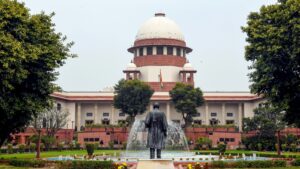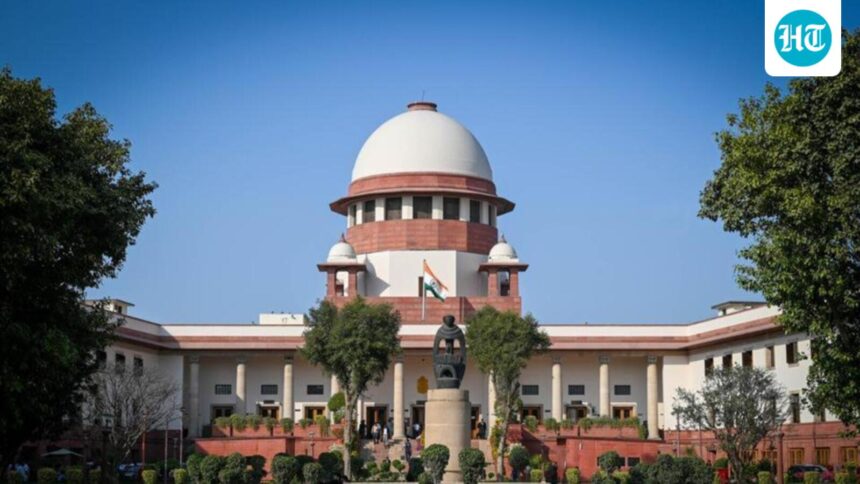
The Supreme Court on Thursday ordered the immediate confiscation of physical copies and removal of digital copies of the controversial Class 8 social science textbook which includes a section on ‘corruption in the judiciary’.

What happened?
The National Council of Educational Research and Training (NCERT) released the textbook for Class VIII Social Sciences Part 1 in July 2025 and Part 2, which contains a section on ‘Judicial Corruption’, on Monday (February 23, 2026). Both books were intended for the 2025–26 academic session, but the first part was released in July 2025, three months after the start of the 2025–26 academic session. The now-retracted sequel was released just a month before the end of the 2025–26 session.
The second part was withdrawn from sale at NCERT bookstore on January 24 (Tuesday), hours after 32 copies were sold. The Supreme Court took suo motu cognizance of the matter on the morning of February 25 (Wednesday), and by night, NCERT, in a statement, apologized for the “inappropriate content” in the chapter titled ‘Role of Judiciary in Our Society’ and said it would be rewritten in consultation with relevant authorities.
On February 26, the Supreme Court ordered a blanket ban on the book and directed the Union government to take action to stop the publication of the book in digital and physical form. The government told the court that 32 copies had been sold and were “being withdrawn.” The apex court also issued show-cause notices to the director of NCERT and secretary of the school education department, asking why no criminal contempt proceedings were initiated against them.
The Education Ministry has written to the Ministry of Electronics and Information Technology (MeitY) and the Ministry of Information and Broadcasting (I&B) to take immediate action in compliance with the Supreme Court order and submit a report on the action taken by February 27, so that the compliance certificate can be registered before the court.
The court ordered that the necessary measures be taken against those involved in writing the book. Union Education Minister Dharmendra Pradhan promised to take action.
How are NCERT books developed?
Although Solicitor General (SG) Tushar Mehra assured the court that action would be taken and that the individuals who prepared the chapter “will never be associated with any activity of this ministry in the future”, and Pradhan stated that the government would conduct an investigation, fix accountability and take action against those involved in drafting the disputed content, people familiar with the development process said that preparation of the textbook for NCERT follows a multi-stage collective process with “no single author responsible for the individual chapters”.
For each subject, a Curriculum Group (CAG) is formed, which forms the textbook development team to draft the chapters. Initial drafts may be written by contributors (academics) or invited subject matter experts and then reviewed at multiple levels – by the development team, external experts, teachers and faculty at CAG, NCERT and finally the National Curriculum and Teaching and Learning Subjects Committee (NSTC).
The controversial chapter mentioning corruption in the judiciary in the textbook for Class VIII NCERT Social Sciences Part II was written by a committee of members, which included a lawyer, but was not reviewed by anyone from the legal fraternity, officials familiar with the matter told HT on Thursday.
“These contents included in the new book are in line with new teaching methods, as mandated by the NEP 2020, which ask students to investigate, explore and respond to complex questions, real-world challenges and problems,” people familiar with the development said.
Is corruption mentioned in the judiciary only?
No, the above-mentioned officials also pointed out that the previous eighth-grade social science textbook – which was in use until 2024 – did not mention corruption at all.
Corruption appears in both the new seventh-grade and eighth-grade textbooks—both of which have two parts each. HT has seen copies of textbooks. These textbooks mention “corruption in public office,” the legislature, and during the electoral process—but not in the judiciary. They discussed corruption across institutions, noting that vigilance committees can be approached in cases of violations. The textbooks explain that elected members can be removed if they are found to be involved in “corruption,” and point to broader democratic challenges such as “wealth disparity,” “erosion of judicial independence,” and manipulation of information. They ask the students why, despite strong regulations, “we still hear about cases of bribery and corruption in public office.”
The first part of Grade 8 Social Sciences, released in July 2025, also highlights political corruption, including financial power in elections and candidates with criminal records.
Is this the first time that NCERT writers have reached the court?
No, but the current judicial scrutiny of NCERT textbooks by the Supreme Court is unprecedented.
One of the most significant cases of judicial intervention in relation to NCERT textbooks was in 2002-2003, when curriculum changes introduced under the National Democratic Alliance (NDA) government were challenged before the Supreme Court of India. In Aruna Roy v. Union of India (2002), the petitioners alleged that the new NCERT syllabus encourages “saffronization” and violates secular principles. However, the Supreme Court upheld the validity of the National Curriculum Framework (NCF) 2000 and allowed the use of the revised textbooks.
An NCERT book has never been “banned” before, though many of it were withdrawn or sections were deleted after various controversies, an NCERT official said.
In 1978, the Janata Party government withdrew RS Sharma’s “Ancient India” from the CBSE syllabus, citing objections that the book’s Marxist interpretation of history and references such as beef-eating in ancient India hurt religious sentiments and were “anti-national”. In 2002-2003, under the NDA government, new history textbooks were accused of “saffronization” for promoting a Hindu nationalist perspective and belittling medieval Muslim rulers. In 2004, the incoming United Progressive Alliance government reversed these changes by canceling the books, appointing review committees of historians, and developing new texts under the 2005 National Curriculum Framework.
In 2012, a cartoon in a political science textbook for Class 11, The Indian Constitution in Action, depicting BR Ambedkar and Jawaharlal Nehru, led to protests, after which NCERT consultants Yogendra Yadav and Suhas Palshekhar resigned and several cartoons were deleted from the book.
Between 2022 and 2024, “rationalization” of NCERT books resulted in the removal of chapters on the Mughal Empire, references to the 2002 Gujarat riots and 1984 anti-Sikh riots, Darwin’s theory of evolution, and parts on social movements and environmental issues.
Academics versus judiciary
While the Bar Association and the legal fraternity criticized the new NCERT book, with Chief Justice of India Surya Kant saying that there “appears to be a deep-rooted and well-planned conspiracy to discredit the judiciary”, a section of academics denied the charge.
Former NCERT director G S Rajput said the controversy had “damaged” the image of the board. “The new textbooks point out corruption in the executive and legislature, and students should learn about such issues to become informed citizens. Many in the legal fraternity may not have read the books completely. Over time, NCERT could have shown in court that the judiciary has not been left out,” he told HT.
He told ANI that NCERT amends its books every year as per the suggestions received. “We are all human, and to make mistakes is human. The Supreme Court makes mistakes too. When someone is acquitted after 15 years and is said to be innocent, imagine how that individual will feel. But no one is charged with incorrect judgement. So why is this happening with NCERT only? What is the reason for this cruelty?” he added, saying it hurts him. Hearing the things said in court, including the words the Supreme Court used — conspiratorial and scandalous — “were not needed at all.”
A person familiar with the development process of the new NCERT book said: “These contents have been included in the book in line with the new teaching methods, as mandated by the NEP 2020, which asks students to investigate, explore and respond to complex questions and real-world challenges and problems.”