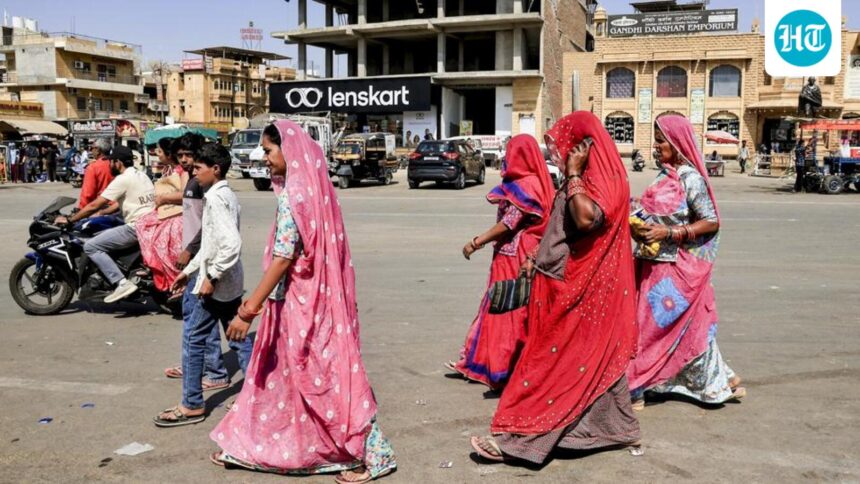
Daytime temperatures in large parts of northwest India are likely to remain 3-5 degrees Celsius above normal over the next week, the India Meteorological Department (IMD) warned on Friday, adding that night temperatures in several states are already significantly higher than normal.

According to the IMD, minimum temperatures are currently between 3 and 5 degrees Celsius above normal in parts of the region, especially Jammu and Kashmir, Rajasthan and Punjab, and are expected to remain high next week.
Maximum temperatures were significantly above normal (more than 6.5°C) in Jammu and Kashmir; Significantly above normal by 3-5°C in Himachal Pradesh, Punjab, Haryana, Chandigarh, Delhi, Rajasthan, Uttar Pradesh and Gangetic West Bengal; And by 2-3 degrees Celsius in Madhya Pradesh, Vidarbha and Assam. Temperatures were close to normal in the rest of the country.
Minimum temperatures were significantly higher than normal by around 3-5 degrees Celsius in Jammu and Kashmir, Punjab, Rajasthan, Gujarat and Assam; and above normal (1.6°C to 3.1°C) in Himachal Pradesh, Uttarakhand, Delhi, Uttar Pradesh, Bihar, Madhya Pradesh, Maharashtra, Odisha, interior south Karnataka, coastal Andhra Pradesh, Yanam, Rayalaseema, Tamil Nadu, Kerala and Mahe. It remained close to normal in other areas.
“Ahead of Holi (March 4), day and night temperatures may be high. Daytime temperatures are particularly likely to be around 4 degrees Celsius higher than normal. This is mainly due to clear skies and absence of any weather activity,” said Mahesh Palawat, Vice President, Climate and Meteorology, Skymet Weather.
On Friday, Safdarjung recorded a maximum temperature of 30.2 degrees Celsius, which was 4.1 degrees Celsius higher than normal.
Meanwhile, the IMD also stated that the upper air cyclonic circulation is located over Kutch and adjoining areas at lower tropospheric levels. There is another such circulation in southern interior Karnataka. The basin extends from northern Tamil Nadu to southwestern Madhya Pradesh in the lower tropospheric levels. There is also an upper air cyclonic circulation over western Rajasthan and neighboring Pakistan. A cyclonic circulation is located over Kerala and its adjoining areas, and another over northeastern Assam. A small basin runs from the southeastern Bay of Bengal to southern Tamil Nadu. A weak western disturbance is currently affecting the western Himalayan region, while a new western disturbance is likely to affect the region from the night of March 2.
The department said maximum temperatures are likely to gradually rise by 2-4 degrees Celsius over the plains of northwest India over the next seven days and remain 3-5 degrees Celsius above normal in many parts of the region this week. No significant change in maximum temperatures is expected over central India during the next 24 hours, followed by a gradual rise of 2-4 degrees Celsius over the next six days. East India is also likely to see a gradual rise of 2-3 degrees Celsius over the next three days, with no significant change after that.
Since January 1, the country has recorded a rainfall deficit of 59% overall, including 90% in eastern and northeastern India, 53% in northwestern India, 78% in central India, and 1% in southern peninsular India.