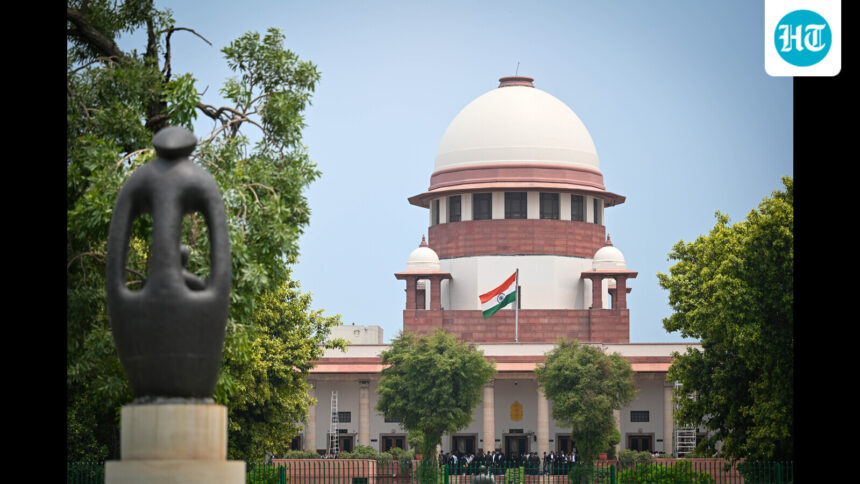
The Supreme Court on Wednesday said it was open to referring the issue of granting retrospective environmental clearance for mining and development projects to a five-judge Constitution Bench after being convinced that the same issue decided by a three-judge bench in November last year required a reconsideration.

A bench headed by Chief Justice of India (CJI) Surya Kant made these observations while hearing a batch of petitions challenging the Ministry of Environment, Forest and Climate Change (MoEFCC) notifications of 2017 and 2021 that allowed the project proponents to get EC long after the work had begun.
A group of petitions filed by NGOs and other individuals claimed that these directives contravened the former European Community legal regime set out in the 2006 Environmental Impact Assessment (EIA) Notification and would negatively impact the environment.
Last year, on May 16, a two-judge bench struck down the two notifications as unconstitutional paving the way for the retrospective demolition of all projects that had applied for the EC. In a review petition decided by a three-judge panel on November 18, that decision was overturned and the challenge to the notices, which was heard on Wednesday, was revived.
“The question of referring the matter to a five-judge bench will arise if we question the November 18 judgment of the three-judge bench,” the bench, also comprising Justices Joymalia Bagchi and Vipul M Pancholi, said.
The court was responding to the arguments of the petitioners – non-profit organizations Vanashakti and One Earth One Life – who, under the November ruling, had requested that the rulings relied upon before the two-judge panel be set aside. While the review judgment set aside the earlier ruling and ordered the matter to be placed for further consideration, the petitioners led by senior advocates Gopal Sankaranarayanan and Sanjay Parikh argued that any effective hearing would require the matter to be placed before a five-judge bench.
“The judgments of this court which held the EC to be retrospectively bad as a matter of law are hereby held (of November 18) to have no precedent value. This judgment represents an obstacle in my way because that case law is not available to me anymore,” Sankaranarayanan said.
In support of this view, Parikh said: “The three-judge bench was not very enthusiastic about laying down the law, which it could not do in the review proceedings. The review judgment practically gave a result in favor of the two notifiers. Naturally, that becomes an obstacle, which is why a larger bench should consider this issue.”
The court assured the petitioners: “We do not prevent you from pleading on the merits. We will respond with a composite ruling in all cases.” The court postponed the case until Thursday to continue hearing the petitioners’ defenses.
Additional Solicitor General (ASG) Aishwarya Bhatti representing MoEFCC said that even the Center is ready to argue on the merits. Although the Center did not file a review petition against the May 16 ruling quashing its notifications, the three-judge bench heard the Union, some states and public sector entities before issuing the order.
Parikh said that this issue is of utmost importance because any relaxation of environmental standards will have a disastrous impact on people and their health. “The decision of the three-judge bench has run counter to several judgments of this court which strengthen environmental jurisprudence. It is contrary to the rule of law as it benefits violators of the law at the expense of those who have obtained earlier EC under the prescribed scheme,” Parikh said.
Advocate Vanshdeep Dalmiya, also appearing for Vanashakti, said that if the EC were allowed to do so retrospectively, there would be no deterrent against defaulters, as the Jan Vishwas (Sentencing Amendment) Act, 2023 had decriminalized violations under the Environment Protection Act, 1986, allowing defaulters to escape with minor penalties.
The November 18 judgment was passed by a 2:1 majority that included then CJI BR Gavai and Justice K Vinod Chandran with the third member, Justice Ujjal Bhuyan, writing a separate dissenting opinion upholding the May 16 judgment of which it was a part.
If the provision under review is allowed to stand, the majority opinion said, public infrastructure that includes hospitals, airports, liquid waste treatment plants and other public works deserves more attention. $20,000 crores will require demolition.