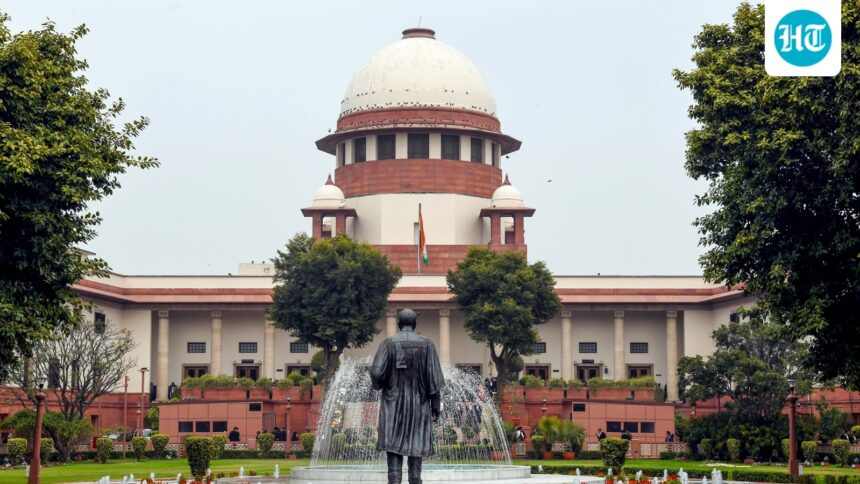
For generations of Indians, a cup of ruby-red Rooh Afza has meant summer comfort – stirred into cold water, milk or desserts, and served at breakfast tables and family gatherings alike. On Wednesday, the Supreme Court settled a long-running tax battle over the popular drink, ruling that Rooh Afza sharbat cannot be pushed into a higher tax bracket simply because it is marketed as “sherbet.”

Noting that the drink derives its identity as a beverage from fruit-based ingredients and is meant for dilution and consumption, a bench of Justices B V Nagaratna and R Mahadevan held that Rooh Afza qualifies as a “fruit drink” under the Excise Code.
Allowing a batch of appeals filed by Hamdard Laboratories (WAKF), the manufacturer of RoohAfza, the court set aside the 2018 rulings of the Allahabad High Court and tax authorities that classified the product as an “unclassified” item taxable at 12.5% under the remaining entry of the Uttar Pradesh Value Added Tax (UPVAT) Act.
Instead, the bench held that RohAfza could be classified under Entry 103 of the Second Schedule (Part A) of the UPVAT Act as a “fruit drink/processed fruit product”, attracting a concessional VAT rate of 4% during the relevant assessment period between 1 January 2008 and 31 March 2012.
The crux of the dispute was whether Rooh Afza, which contains 10% fruit juice (8% pineapple and 2% orange) mixed with invert sugar syrup and herbal distillates, could legally qualify as a “fruit drink”, or whether it should fall into the remaining basket designated for goods not specifically classified elsewhere.
Read also | New GST rates: Complete list of items under the new tax slabs. These items will become cheaper
Revenue authorities relied heavily on a clarification issued under the Food Safety Regulations stipulating that a “fruit drink” must contain at least 25% fruit juice. Since RoohAfza contains only 10%, it is described for licensing purposes as “a non-fruit drink containing 10% fruit juice”. On this basis, the administration said it could not be treated as a fruit drink for tax purposes.
The Supreme Court rejected this reasoning, explaining that regulatory classification under the Food Safety Act cannot control fiscal interpretation unless the tax law expressly adopts such definitions.
“It is trite for fiscal law to be interpreted in its own language,” the council said, stressing that food regulatory standards operate in a distinct field of quality and safety control and do not determine tax classification.
Since the term ‘fruit drink’ was not defined in the UPVAT Act, the court applied the ‘common language test’ – how the product is understood in the commercial and popular sense. He noted that classification should be based on tangible factors such as composition, mark, character and intended use.
The court also applied the “substantial character test,” holding that although invert sugar syrup constitutes approximately 80% of the volume, it acts only as a carrier and preservative. The distinct flavour, aroma and identity of the beverage is derived from the fruit juice and the distillates associated with it.
“Mechanical reliance on quantitative dominance would be misplaced,” the court stressed, adding that classification should follow the ingredient that gives the product its basic beverage character.
In particular, the Court stressed that supplementary restrictions can only be relied upon when the goods cannot reasonably be included under any specific restriction and that the burden falls squarely on Revenue to prove that classification under a specific restriction is not possible.
In this case, the court noted that the administration had not provided any commercial inquiries, consumer surveys or market evidence to prove that Rooh Afza was not commercially understood as a fruit-based drink. It considered that relying solely on nomenclature and licensing rules was insufficient.
The Board further noted that similarly worded VAT entries in several states, including Delhi, Gujarat, West Bengal, Madhya Pradesh and Andhra Pradesh, treated the product as a fruit-based beverage eligible for concessional tax rates of 4-5%. The court said that while VAT classification is a governmental subject and not binding across jurisdictions, such uniformity carries evidentiary value in assessing commercial understanding.
“Where there are two reasonable views, the interpretation favorable to the assessee shall prevail,” the bench held, directing the Uttar Pradesh authorities to grant consequential reliefs, including recovery or adjustment of excess tax paid under protest — amounting to more than $26 million, according to the law.
To be sure, the ruling is limited to the VAT system that existed before the GST came into effect. Under GST, fruit-based beverages fall under tariff head 2202 and attract 2.5% tax.