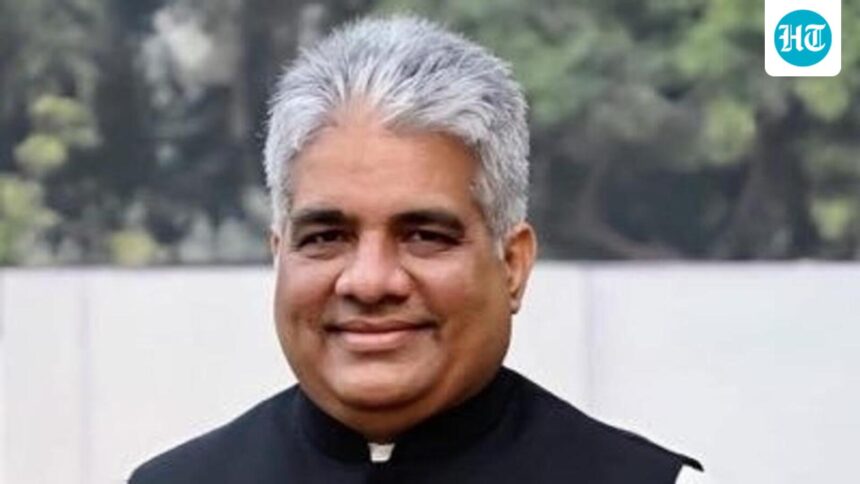
India’s Climate Action Vision goal includes achieving 500 GW of non-fossil fuel power by 2030, net zero by 2070, advancing the National Green Hydrogen Mission and building climate-resilient infrastructure, Union Environment Minister Bhupinder Yadav said on Wednesday.

“The climate vision must be grounded in realism and underpinned by ambition, and India’s vision is clear,” he said in his address at the Silver Jubilee edition of the World Summit on Sustainable Development organized by the Energy and Resources Institute (TERI). But he warned that this transformation will also require a global vision. This includes tripling renewable energy globally; Double energy efficiency; Expanding adaptation finance to match mitigation finance and reforming multilateral development banks to unleash trillions in climate finance.
“Climate ambition and climate finance must advance together,” he said. “When financial mechanisms are transparent, predictable and inclusive, the transformation moves from promise to practice.”
Yadav also said that the first global assessment (at COP28 in Dubai in 2023) under the Paris Agreement has made one fact unambiguously clear. “Globally, we are not on track to limit global warming to 1.5 degrees Celsius. Emission reductions remain insufficient. Financing for adaptation remains insufficient. Implementation of the Sustainable Development Goals is uneven. This is not a crisis of science. It is a crisis of scale, speed and systemic alignment,” he said, adding that the transition must go beyond mere gradual policy refinement. “It must change the architecture of energy systems, economic models, consumption patterns, and global governance frameworks.”
Yadav emphasized that India consistently upholds the principles of common but differentiated responsibilities, climate justice, fair carbon space, and inclusive carbon markets. He said: “These are not negotiating positions, but rather the foundations of permanent cooperation.”
Yadav’s comments are particularly important because the United States, the largest historical emitter, last month withdrew from 66 international organizations and agreements, and its most significant exit, from the United Nations Framework Convention on Climate Change (UNFCCC), is likely to deal a devastating blow to global efforts to address the climate crisis.
The United Nations Framework Convention on Climate Change was adopted in 1992 to provide a legal basis for climate talks. All meetings of the Conference of the Parties are held under its auspices. The 2015 Paris Agreement was the result of these discussions. Nearly 200 countries have ratified the UNFCCC, with the United States being the first developed country to do so (after its Senate approval). Now, with the United States withdrawing from the agreement, several parties have asked how to achieve justice for countries that were not historically responsible for the crisis.
Bharrat Jagdeo, Vice President of Guyana who also addressed the conference, said the biggest issue facing the world now is the need to raise ambition to achieve climate goals.
Read also: Global climate efforts hit as US withdraws from key bodies
“With the United States of America off the table, at this time when we have to raise ambition, it will be very difficult for us to achieve climate goals without the United States participating. That will have implications for carbon pricing systems that are essential to growing the climate sector, and it will have implications for multilateral systems that are critical for sustainability. I’m talking here about aviation and shipping, regulatory fulfillment and many other sectors that are critical without the United States again, which will be very difficult, so I think the challenge for this gathering here is to find ways to do so,” Jagdeo said. “We can move forward even without the United States.”
Siddharth Sharma, CEO of Tata Trusts, said there is an inherent bias in the way narratives are framed.
“When we talk about India being the fourth largest economy, we are told that this is a good thing but it depends on the population because you have a population of 1.4 billion, but if you look at per capita GDP, you are still at around US$2,500 and so on and you are still a low-income country. But when you talk about emissions and when we say that per capita emissions are less than the global average by about half or almost a third, we are told no, that is not what matters, what matters is your absolute number,” Sharma said.
“So you see how the narratives change and so I think the one thing I would emphasize is that if you see the entire arc of civilization and how the industrial age and the industrial revolution happened, what we call the developed countries of the world had a complete arc of many years to achieve their development journey and in the process exhausted a lot of the carbon budget of the planet,” Sharma said.
“Countries like India, which has one-seventh of the population, do not have this luxury because we have faced a problem that is not of our making, but we have to participate in the solution because we know that when we talk about climate change and its harmful effects on people’s quality of life, there is inequality not only between countries, there is inequality within countries, and therefore between people who live on the margins of society,” Sharma added.