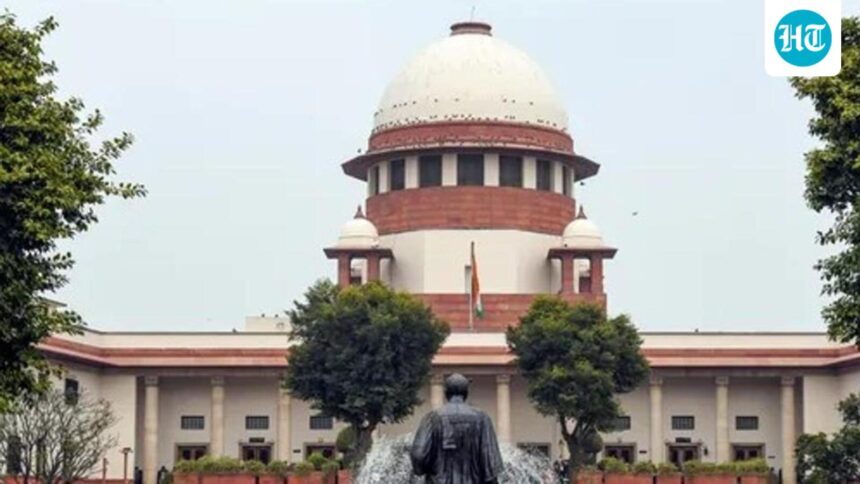
The Supreme Court on Monday said the Union government will have to convince it that the drastic reduction in the qualifying percentage for NEET-PG 2025 counseling – “almost to zero” – does not affect the quality of medical education in the country.

“You have to convince us that this drastic reduction in the cap, which effectively takes it to zero, does not affect the quality of education. We are concerned about the quality of medical education,” Justices B S Narasimha and Alok Aradhy told the Centre’s lawyers.
The court issued formal notices on a batch of petitions challenging the reduction in the cap and sent the matter for hearing next week.
Senior advocates Pinky Anand, Gopal Sankaranarayanan and DS Naidu appeared for the petitioners, while Additional Solicitor General Aishwarya Bhatti represented the Centre.
Read also: The Supreme Council ordered the deployment of district court judges to supervise the Bengal SIR
In its affidavit filed before the court, the Union government defended the decision to reduce the qualifying percentage, arguing that the National Eligibility Test for Admission to Postgraduate Courses (NEET-PG) is not intended to certify minimum clinical competency.
“NEET-PG is not intended to certify the minimum competency prescribed by MBBS qualifications themselves for candidates, but to create a common merit list for allotment of limited seats for postgraduate studies. NEET-PG scores are a function of relative performance and examination design which cannot be construed as identifying clinical incompetence,” the affidavit said.
The Center emphasized that all the candidates appearing for NEET-PG are already qualified MBBS doctors, who have completed 4.5 years of academic training in multiple medical specialties, followed by one year of compulsory training. To obtain the degree of MBBS, candidates must obtain at least 50% marks separately in theoretical and practical examinations.
Addressing patient safety concerns, the affidavit emphasized that graduate training is a supervised process. “All candidates admitted to postgraduate courses are already licensed MBBS practitioners. As MBBS doctors, they are entitled to practice independently. During postgraduate training, candidates work under the continuous supervision of senior faculty and specialists,” the statement said.
The Center also stressed that MD/MS degrees require candidates to obtain at least 50% marks separately in theoretical and practical examinations at the graduation stage, without any leniency, thus maintaining standards at the point of certification.
The decision to reduce the percentage was taken by the Ministry of Health and Family Welfare in consultation with the National Medical Commission in view of the large number of vacant seats expected, the affidavit said.
For the academic session 2025-26, around 70,000 postgraduate seats were available, while 2,24,029 candidates appeared for NEET-PG. Of the 31,742 seats under the all-India quota, 9,621 seats remained vacant after the second round of counselling. Of these, 5,213 seats were vacant in government medical colleges, including AIQ and DNB seats.
According to the government, the percentage reduction will make 1,00,054 more candidates eligible for the third round of counseling, taking the total number of eligible candidates to 2,28,170.
Postgraduate medical seats represent a major public investment in infrastructure, faculty and hospital facilities, the affidavit said. Leaving these seats vacant would waste national resources and negatively impact the provision of specialized health care. She added that even after the percentage reduction, seat allocation remains strictly on the basis of merit and candidate preference.
After the completion of the third round of AIQ consultations, 2,988 seats remain vacant and will be available in the next round, the Center informed the court.
The union also noted that a reduction in the qualifying percentage is not unprecedented. Since the inception of NEET-PG in 2017, percentage reductions have been made in appropriate circumstances to prevent wastage of seats. Also in the 2023 academic year, the eligible percentage has been reduced to zero across categories.
The affidavit also said that political decisions fall outside the scope of judicial review unless they are proven to be clearly arbitrary, bad faith, or violate statutory or constitutional provisions.
Earlier, the National Board of Examinations in Medical Sciences (NBEMS) had submitted a separate affidavit stating that it had no role in taking the decision to reduce the qualifying percentage and that the decision to reduce the cut-off, as submitted, was taken by the Directorate General of Health Services under the Ministry of Health and Family Welfare in consultation with the National Medical Commission.
According to NBEMS, the reduction in the ceiling has increased the number of eligible candidates from 1,28,116 under the earlier norms to 2,24,029 under the revised norms, making an additional 95,913 candidates eligible to participate in the counselling.
The petitions before the Supreme Court seek to quash the January 13, 2026 notification issued by NBEMS notifying the revised cut-off scores, restore the minimum qualification standards and discontinue counseling being conducted under the reduced cut-off score. They argued that lowering the threshold to what they describe as abnormally low — even zero or negative levels — amounts to an unconstitutional dilution of minimum standards in postgraduate medical education, endangering public health and violating Section 21 of the Constitution. They noted that after the review, candidates who scored as low as -40 out of 800 are now eligible to participate in counselling. They assert that allowing these candidates to compete for postgraduate medical seats undermines the regulatory framework that governs professional education and weakens meritocracy.