Prime Minister Narendra Modi on Sunday praised the recently concluded India AI Impact Summit, saying the event proved to be a turning point in how the world will use artificial intelligence in the future. It also provided a comprehensive overview of an India in transition – confident in new-age technologies, rooted in ancient knowledge systems, and increasingly shaped by everyday acts of compassion, civic vigilance, and cultural pride.

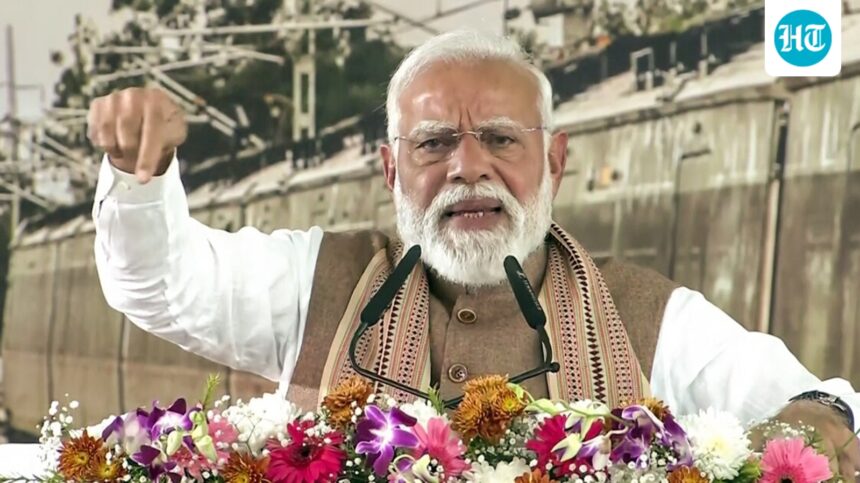
“Leaders of several countries, industry leaders, innovators and people associated with the startup sector gathered at Bharat Mandapam to attend the AI Impact Summit. This summit has proven to be a turning point in how the world will use the power of AI in the future,” the Prime Minister said while addressing the nation on the 131st episode of his monthly radio show Mann Ki Baat.
The Prime Minister drew attention to two exhibitions that he said left world leaders “deeply impressed.” One was at the Amul booth, where AI-powered tools are being used to monitor animal health and support dairy farmers with round-the-clock digital assistance. The second topic focused on preserving India’s cultural heritage through technology, explaining how to restore ancient manuscripts digitally and make them available to new generations.
As an example, Modi cited the digitization of Sushrut Samhita, explaining how faded manuscripts are first enhanced for readability, converted into machine-readable text, interpreted by AI avatars, and then translated into multiple Indian and foreign languages. He said that this process showed how Indian cultural knowledge can be shared globally in a modern form.
“At this summit, the world got to see India’s amazing capabilities in the field of artificial intelligence. During this period, India also launched three made-in-India AI prototypes. This in itself was the biggest AI summit ever. The enthusiasm and enthusiasm of the youth regarding this summit was worth watching. I congratulate all the citizens on the success of this summit,” he said.
Moving from technology to sports, the Prime Minister spoke about cricketers of Indian origin who are representing countries like Canada, the United States and Oman in the ongoing T20 World Cup. Mentioning several players, he said their journeys reflect the essence of “Indian identity” – preserving cultural roots while contributing fully to the nations they now represent. “There are countless players of Indian origin who take pride in their countries… and become an inspiration to the youth there… Wherever Indians go, they stay connected to the roots of their motherland and contribute to the development of Karambhoomi, the country in which they live and work,” he said.
A deeply emotional portion of the speech focused on organ donation, and was based on the story of Aline Shireen Abraham, a 10-month-old girl from Kerala whose parents chose to donate her organs after her death. Prime Minister Modi described the decision as an extraordinary act of courage and compassion, noting that Allen had become one of the youngest organ donors in the country. “Friends, awareness about organ donation is steadily increasing in India these days. This helps those who need it. It also enhances medical research in the country. Many organizations and individuals are doing exceptional work in this direction,” he added.
The Prime Minister also spoke about getting rid of symbols of the colonial legacy, announcing that a statue of C Rajagopalachari, the first Indian Governor-General of independent India, would be installed at Rashtrapati Bhavan in place of that of British architect Edwin Lutyens.