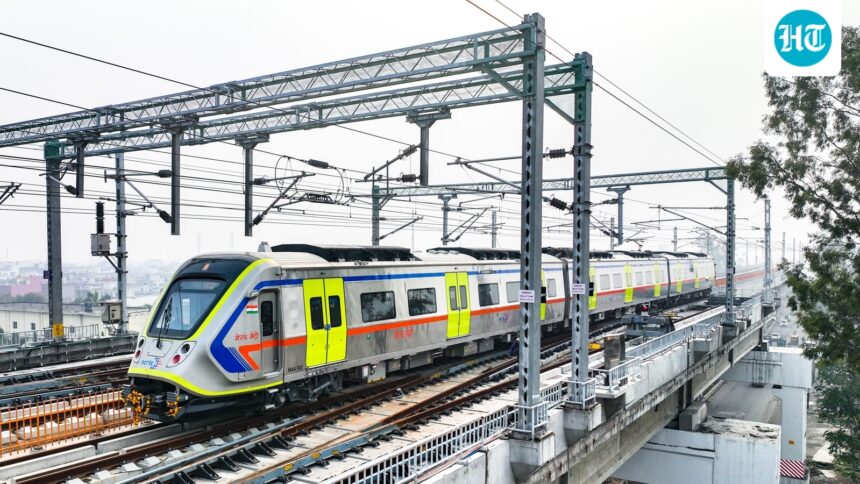
Prime Minister Narendra Modi on Sunday inaugurated the Namo Bharat Regional Rapid Transit System (RRTS) and Meerut Metro, India’s fastest local metro rail system with a maximum operational speed of around 120 kmph, running between Meerut South and Modipuram.

The Meerut Metro will run on the same infrastructure as the Namo Bharat RRTS that connects the national capital to parts of Uttar Pradesh like Ghaziabad, Sahibabad, Modinagar and Meerut, according to a government statement. This RRTS operates at speeds of up to 180 kilometers per hour.
Also Read: Delhi-Meerut RRTS now fully operational: Will improved connectivity increase demand for properties along the corridor?
Prime Minister Modi was accompanied by Uttar Pradesh Chief Minister Yogi Adityanath, Uttar Pradesh BJP president, Pankaj Chaudhary and other officials when the metro train started from Shatabdi Nagar Namo Bharat station.
Modi said that areas that were deserted after sunset are now connected to modern, safe and efficient transportation systems. He was quoted as saying, “Everyone can remember the good old days. Sisters and daughters in particular told me that a few years ago, the entire road used to fall silent after the evening. There was an atmosphere of fear and apprehension. Now, the law and order system has improved, and people enjoy comfortable and safe travel.”
After announcing the two railway projects, Modi took a metro ride to Meerut South station, where he interacted with students.
Everything you need to know about Namo Bharat RRTS
- The newly inaugurated stretches of the Namo Bharat RRTS include a 5-km section between Sarai Kale Khan and New Ashok Nagar in Delhi, as well as a 21-km section connecting Meerut South to Modipuram in Uttar Pradesh.
- The UP CM said the Namo Bharat RRTS will reduce the travel time between Delhi and Meerut from four-five hours to about 45-50 minutes.
- Namo Bharat is India’s first regional rapid transit system with a design speed of 180 km per hour.
- Namo Bharat RRTS will connect the national capital Delhi to major urban centers of Uttar Pradesh like Sahibabad, Ghaziabad, Modinagar and Meerut.
- The original stop of the trail is Sarai Kale Khan in Delhi.
- It is strategically located as a major multi-modal hub, seamlessly connecting Hazrat Nizamuddin Railway Station, Delhi Metro’s Pink Line, Veer Haqeeqat Rai ISBT and Ring Road.
- Shatabdi Nagar, Begumpul and Modipuram are the three Namo Bharat stations commissioned in Meerut.
Everything you need to know about Meerut Metro, the fastest metro service in India
- Meerut Metro will run on the same infrastructure as Namo Bharat RRTS.
- Meerut Metro is touted as the fastest metro service in India with an operational speed of 120 kilometers per hour. For context, the regular lines of the Delhi Metro operate at an average speed of 45-75 kilometers per hour.
- The Merut Metro will cover the entire distance in just 30 minutes, with all stops scheduled en route.
- Due to the integrated model of Meerut Metro, passengers can easily switch between regional and intra-city services and do not need to step out of the station premises.
With inputs from PTI