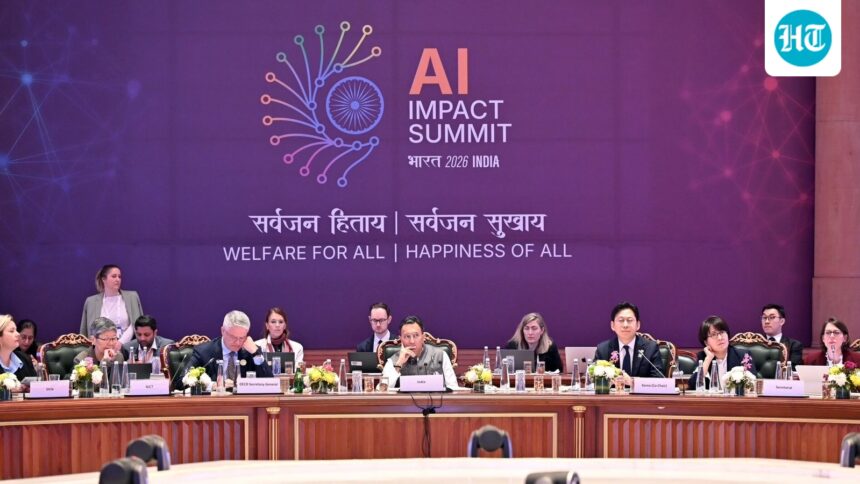
New Delhi: For much of the world, the barriers to AI are not philosophical but practical: the cost of computing power, the absence of reliable internet, and the shortage of trained workers. The New Delhi Declaration on AI, adopted on Saturday by 88 countries and international organizations, puts these concerns at the heart of global AI governance for the first time.

The declaration argues that “robust digital infrastructure and affordable, meaningful connectivity are prerequisites for deploying AI and unleashing its full potential,” calls for “scaling up professional and training ecosystems” and “training public servants” in AI, and positions affordable AI systems as a way to “accelerate local innovation” in developing economies.
It supports open source AI – qualified by “where appropriate” – as a tool for scalability across regions that cannot build proprietary systems from scratch.
The AI Impact Summit 2026, hosted by India, is the first in the history of the four global AI governance summits to be held in the Global South – and the shift in geography is reflected in the shift in focus.
“The emergence of artificial intelligence represents an inflection point in the path of technological evolution,” the announcement said, “and the choices we make today will shape the AI-powered world that future generations will inherit.”
Read also | 70 countries have signed the New Delhi Declaration on Artificial Intelligence, and more are expected
The Declaration certainly carries no legal force and does not oblige signatory states to take specific legislative or regulatory measures.
Previous summits at Bletchley Park, Seoul, and Paris have been shaped primarily by the preoccupations of technologically advanced Western nations: existential risks, safety standards, and regulatory frameworks. New Delhi has not abandoned these concerns — an entire pillar of the declaration is devoted to safe and trustworthy AI — but it has subjected them to a prior question: Who has the right to engage in AI at all.
The declaration has been approved by 88 countries and international organizations, the largest number of signatures to date. This number exceeds the 58 sites at the Paris summit last year, where the United States and the United Kingdom refused to participate. They both signed in New Delhi, along with China, Russia and the European Union.
“[The] The whole world supported the Prime Minister [Narendra Modi’s] Ji’s vision for human-centered artificial intelligence. Union Minister for Electronics and IT, Ashwini Vaishnao, said the announcement was inspired by the principle of Sarvajana Hitaya, Sarvajana Sukhaya, to democratize AI resources for the global population.
The summit announced seven voluntary, non-binding frameworks, including a Charter for Democratic Deployment of AI to promote “access to foundational AI resources” and “locally relevant innovation”; A global AI footprint to replicate successful AI use cases across regions; Trusted AI Commons on “technical resources, tools, standards and best practices”; And an international AI network of scientific institutions to bring together research capabilities globally.