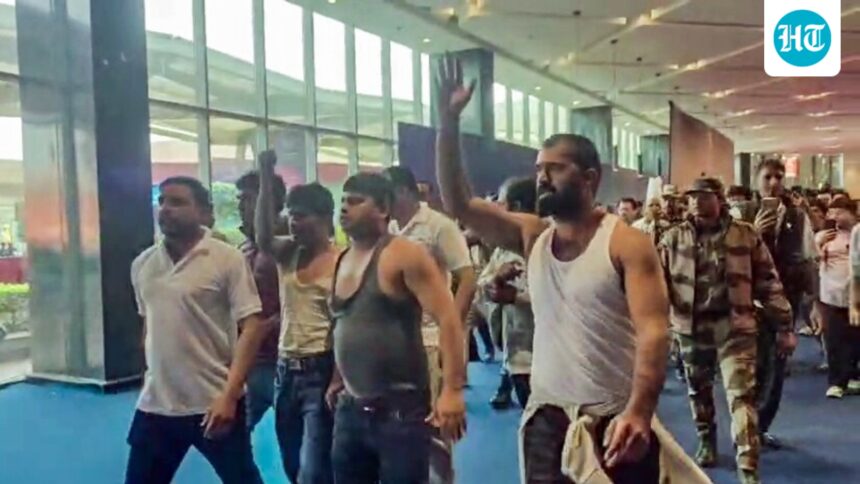
When four Indian Youth Congress (IYC) workers stripped off their shirts inside Bharat Mandapam, the venue for the India AI Impact Summit, in New Delhi on Friday, police saw more than just political theatre. They have seen Nepal from last year.

“This is a The Delhi Police told the Patiala House court in the national capital on Saturday, as the four arrested men — Krishna Hari, Kundan Yadav, Ajay Kumar and Narasimha Yadav — were produced for a remand hearing. The court sent them to police custody for five days, and rejected their requests for bail.
These four men were among Young wing members of Congress entered the summit by registering online, scanning QR codes and donning T-shirts bearing slogans like “India-US Trade Deal”, “Epstein Files” and “PM Vulnerable”.
Once you enter Hall No. 5 They took off their shirts and raised anti-Modi slogans. The prosecutor claimed that the protesters raised “anti-national” slogans, and claimed that “money from other organizations” may have been involved. The IYC workers’ defense lawyer described the FIR as “nothing more than a political move”.
One of the four men said as they left the court:“Hardeep Singh Puri must go,” he said, referring to the Union minister named in emails related to US sex offender Jeffrey Epstein. Burri said he knew nothing about Epstein’s crimes when he met him for professional work at the organization more than a decade ago.
‘Rahul’s soldiers’ versus BJP’s wrath
Regarding the shirtless protest, IYC national president Uday Bano Shib did not offer any apologies even as sections within Congress support circles also questioned the manner of the protest.
“This anger is not just from our Youth Congress members. It is from every youth who is unemployed today,” Ship told news agency ANI.
“Our colleagues in the Youth Congress are the same Rahul Gandhi’s soldiers. “They will not be intimidated,” he said.
The protest drew its ideological fuel and salient slogan from Rahul Gandhi’s recent announcement outside Parliament, in which he said that “the Prime Minister is in danger.” Gandhi described the summit itself as a “disorderly public relations spectacle”.
The Bharatiya Janata Party, which rules Delhi center and state, has He made frontal attacks on Rahul Gandhi even more. Union Minister Piyush Goyal Published on X: “This is Congress’ arrogance and frustration on display! So Mr Rahul Gandhi, humiliating India for targeting the government is your idea of dissent?”
The Nepal-Bangladesh model was cited
The Delhi Police’s reference to Nepal in this case was not isolated. References to Nepal, and its other Indian neighbor Bangladesh, have appeared in courtrooms, legislatures and state capitals across India.
The “Generation Z” protests in Nepal in September 2025 toppled Prime Minister KP Sharma Oli’s government in less than two weeks and left more than 70 people dead. A year earlier, a student-led uprising in Bangladesh from July to August 2024 forced Prime Minister Sheikh Hasina to flee by helicopter after 15 years in power. She is now in self-exile in Delhi. These have become the dual reference points for the police and other authorities in India.
The ongoing agitation for legislative rights turned violent in the Union Territory (UT) of Ladakh last year, just weeks after unrest in Nepal. Both Nepal and Bangladesh have been cited in the Supreme Court in this case.
The Center and Ladakh administration defend their arrest of climate activist and agitation leader Sonam Wangchuk, under the National Security Act, appeared before a bench of Justices Aravind Kumar and BB Varali earlier this month.
Solicitor General Tushar Mehta, representing the government, told the court: “He carefully crafted his speech To incite Generation Z and seek unrest as happened in Nepal and Bangladesh and use Mahatma Gandhi’s speeches to cover the real intention.
“He added”[Wangchuk] Does Ladakh want to become Nepal or Bangladesh? This is what he clearly wants to say. We all know what happened in Bangladesh. he It targets impressionable youth.”
Wangchuk was arrested on September 26, 2025, two days after protests in Leh demanding statehood and some autonomy under the Sixth Schedule of the Constitution turned violent, killing four people.
“I don’t know if they were inspired by Nepal, but the way they came out together, no one could have imagined it,” Wangchuk responded before his arrest, telling a virtual press conference. His lawyer Kapil Sibal argued before the Supreme Court that the statements cited to justify the arrest were wrongly attributed to Wangchuk or misinterpreted.
In Assam too, a similar situation emerged in Nepal after the sudden death of beloved singer Zubin Garg in Singapore in September 2025 led to street unrest. Prime Minister Himanta Biswa Sarma drew a line: “This is Assam Zobin. We will not allow it to become Nepal.”
Sarma had previously repeatedly cited Bangladesh while warning of what he described as “destabilization attempts” in northeastern India — a reference that carries particular weight given Assam’s fraught history of illegal migration across the eastern border, and elections scheduled to be held this year in Assam and West Bengal.
What do Nepal and Bangladesh look like now
As for Nepal and Bangladesh, the two countries are moving forward, but not without turmoil.
In Nepal, interim Prime Minister Sushila Karki — a former chief justice of the Supreme Court who took charge after Generation Z protesters debated her appointment online on Telegram and other channels — is leading a transitional government. “This apolitical transitional government has one non-negotiable mandate: to hold free, fair and impartial general elections for the House of Representatives on March 5, 2026,” Karki said recently in the capital Kathmandu. “We are not here to pursue a political agenda, but to pave the way for a new and legitimate agenda.”
Regarding last year’s protests, she said: “That movement was a mirror that sought to put an end to corruption, nepotism, and discrimination. A strong democracy does not suppress discontent, but rather embraces it as an opportunity for reform.”
“No nation can remain peaceful by throwing away its youth,” she added. “Young people possess energy, a moral sense of indignation, and a deep aspiration for change.”
in bangladesh, It appears that the post-protest transitional phase has ended for the time being. Interim leader Muhammad Yunus resigned as chief advisor on February 16 after the Bangladesh Nationalist Party, led by Tariq Rahman, won a landslide victory in the country’s February 12 general elections. These were the first elections in Bangladesh since the overthrow of Sheikh Hasina.
Rahman, who returned from 17 years of exile in London just two months before the vote, was sworn in as prime minister on February 17.
In his speech, he dedicated the victory to:Those who rise up in 2024,” he declared: “This victory is for democracy. This victory belongs to the people who aspire to democracy and sacrifice for it.”
Sheikh Hasina, who was sentenced to death in absentia by a Bangladeshi court, described the elections as a “farce” as her Awai League party remains banned. She called Yunus and the current regime “Fascist,” and described the student-led protest that ousted her in 2024 as a “conspiracy.”