US President Donald Trump has confirmed that there will be no changes in the parameters of the US-India trade deal announced on February 2, following the US Supreme Court’s Friday (February 20, 2026) ruling that the president’s ‘reciprocal tariffs’ were illegal.
Trump’s tariffs were directly rejected by the US Supreme Court
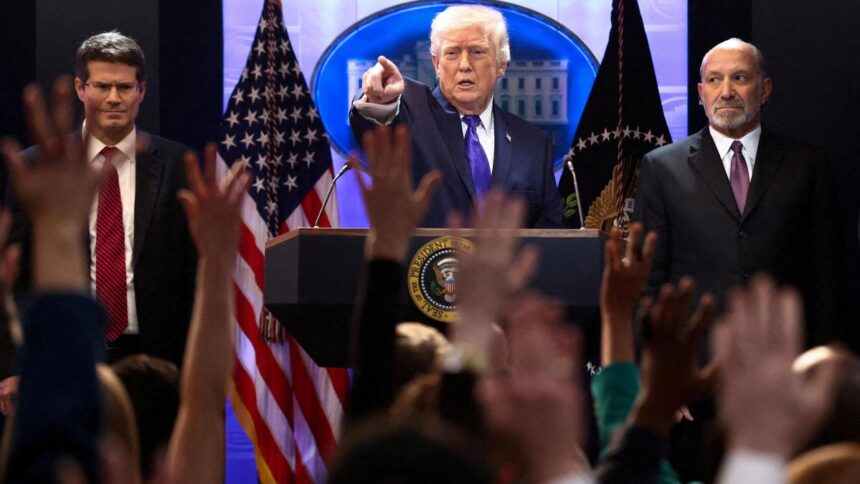
During a press conference where he lashed out at judges who ruled against the tariffs, Trump said he would use alternatives to impose tariffs. The court ruled that he overstepped his authority under the International Emergency Economic Powers Act (IEEPA), the legal instrument that launched his ‘reciprocal tariffs’ announced on April 2, 2025.

“Nothing will change. They will pay tariffs and we will not pay duties,” Mr. Trump said.
“As you know this is the opposite of what has been in the past,” he said, praising Prime Minister Narendra Modi, calling him a “great gentleman”, but adding,
“He ripped us off.”
“So we made a deal with India, and it’s a fair deal now, and we’re not paying them tariffs, and they’re paying tariffs. We’re not flipping,” Mr. Trump said.
The agreed terms of the deal reduced the general tariff rate on Indian goods entering the US from 50% to 18% (including a 25% ‘penalty’ rate on India’s energy trade with Russia).
During the press conference, Mr. Trump says he will sign on Friday (February 20, 2026) a broad 10% across-the-board “global tariff” using Section 122 of the US Trade Act (1974) to take effect in three days.
These tariffs are valid for a maximum of 150 days. He also stressed that Section 232 tariffs (for example, on steel and aluminium) and Section 301 tariffs (relating to ‘unfair’ trade practices) imposed on national security grounds would remain in place. President says 301 inquiries are being initiated. However, it is still unclear what is the legal basis for the overall 18% tariff rate on India.
Asked by a reporter to describe his relationship with India, Trump said it was “fantastic” and that his relationship with Mr Modi was “great”. He immediately stated that India had stopped buying Russian oil at the request of the US. As Mr. Trump has done on several occasions in the past, he has “mostly” stopped the “war” (in May 2025) between India and Pakistan by threatening each country with 200% tariffs.
India withdrew from Russia at my request: Trump
Mr Trump’s taking credit for the ceasefire and India buying less Russian oil (and previously saying it would halt these purchases altogether) is politically sensitive in India. On Friday, Mr. Trump quickly discussed each of these points.
“India pulled out of Russia. You know, India is getting oil from Russia, right? And they pulled out at my request because we want to solve that horrible war that’s killing 25,000 people every month,” Trump said.

“I also stopped the war between India and Pakistan,” he said, adding that 10 planes were shot down during the conflict. Trump also claimed that the conflict could turn into a nuclear conflict
“I said, look, you’re the one [ i.e., India and Pakistan] Going to fight, that’s fine, but you’re not going to trade with the United States and you’re going to pay a 200% tariff. Every nation,” he said, prompting nations to declare their desire for peace.
Trump did not respond to a question on whether he plans to travel to India for the Quad Summit this year. A summit of the group of four countries (India, US, Japan and Australia) was supposed to take place last year, but was called off.
In the press conference Mr. Trump lashed out at some of the judges, using terms like “idiots”, “lapdogs”, “unpatriotic” and saying they were “loyal to the Constitution”. He praised the dissenting minority, calling Justice Brett Kavanagh, for example, a “genius” and saying he was “very proud of him.”