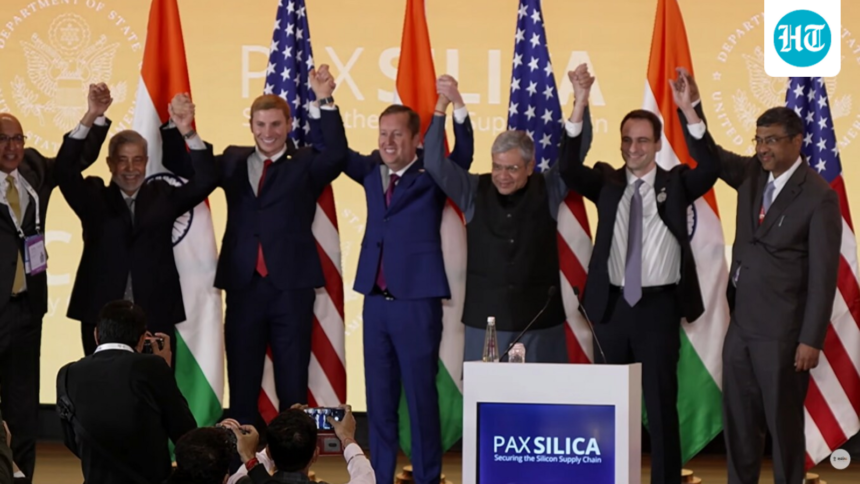
If the 20th century was defined by oil and steel, the 21st century was shaped by silicon. On Friday, India officially joined the Pax Silica – a US-led geopolitical and economic alliance designed to secure the global supply chain for artificial intelligence, semiconductors, and critical minerals – sectors in which China has a near monopoly.

This alliance, brokered by the US State Department, is an initiative to decouple from China. For India, joining PAX Celica represents a strategic pivot – an opportunity to secure billions in technology investments and strengthen its role as a primary alternative to China.
Pax Silica Engineering
Launched in December 2025, Pax Celica is a nod to the Pax Americana – a G7 of sorts for the age of artificial intelligence. The basic premise is that economic security today is inseparable from computing power. Unlike previous narrower chip agreements, PAX Silica takes a comprehensive approach. It coordinates policy across the entire technology stack – from rare earth mining and refining to chip manufacturing and use in basic AI models and data centres.
The group includes Australia, Israel, Japan, the Netherlands, Singapore, South Korea, the United States and the United Kingdom, with Taiwan monitoring. Recent additions such as the UAE and Qatar bring cheap energy to the table. And India, the demographic dividend of being the most densely populated country in the world. And of course the data generated by 1.45 billion citizens.
China problem
While the bloc’s official language emphasizes positive-sum partnerships, the subtext is entirely China-focused. Beijing currently controls more than 60% of the world’s rare earth processing and dominates the legacy chip industry.
Pax Celica embodies the “moving gap” principle adopted by Washington to maintain a permanent technological advantage over China in the field of artificial intelligence and semiconductors.
By coordinating export controls, subsidies, and capital flows between allied states, the Pax Seleka attempts to weaponize interdependence. It effectively draws a “Silicon Curtain” across the global economy, restricting China’s ability to access critical tools required to train AI models while supporting capacity building in allied nations.
India’s entry into Pax Silica
India’s official inclusion this week – coinciding with the India AI Impact Summit in New Delhi – comes two months after its exclusion.
When the Pax Celica was unveiled in late 2025, India was noticeably absent. While India boasts a huge pool of engineering talent and a fast-growing AI market, it lacks the impressive capabilities of Taiwan or South Korea.
But things are changing.
The India-US trade agreement – a preliminary framework of which was signed earlier this month – has led to a thaw in relations.
For PAX Silica to succeed, it needs India’s ore potential, domestic market size, and growing mineral ambitions – as proposed in the 2026 Union Budget. The urgent call to New Delhi by US Ambassador to India Sergio Gore underscores a practical realization: India is indispensable to any viable “China plus one” strategy.
Free market friction
To be sure, membership will not be frictionless.
Pax Silica’s entry opens the door for India companies – such as the Tata Group, which is rapidly expanding its semiconductor footprint – to deepen joint ventures with global chip giants such as Micron and Applied Materials. It also provides New Delhi with a seat at the table in shaping global digital governance.
However, India’s domestic industrial policy may run counter to the spirit of the bloc. New Delhi relies heavily on protectionist measures, massive domestic support, and import regulations to protect its nascent technology sector. Combining these policies with the free market orientations of the Pax Seleka and coordinated anti-dumping measures will require careful diplomatic action.
Ultimately, India’s accession to Pax Celica represents a watershed moment. This suggests that New Delhi is willing to trade a degree of strategic ambiguity for a permanent seat in the elite coalition that determines the future of global technology. In the high-stakes competition for AI supremacy, the battle lines are now clear.