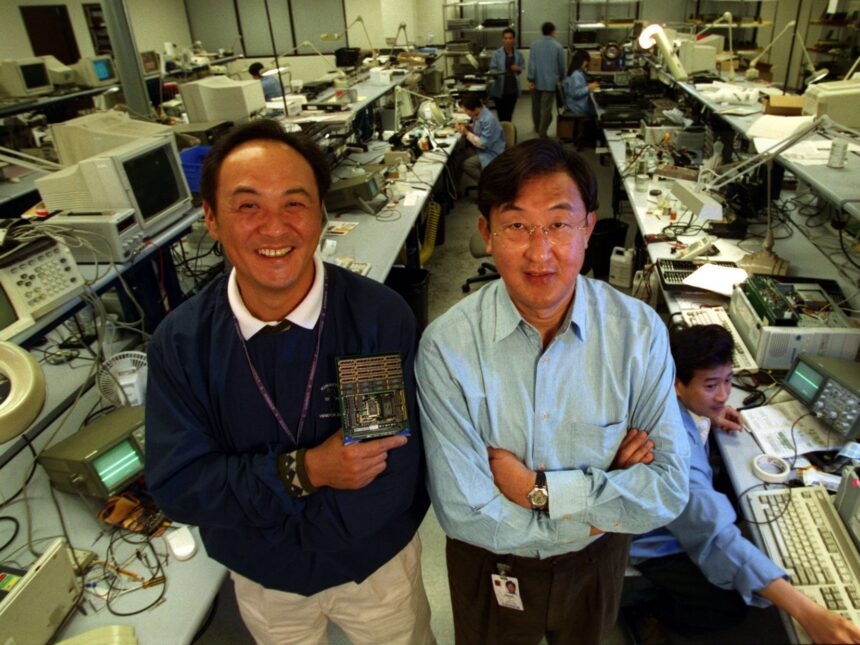

- Two entrepreneurs have seen their fortunes rise thanks to memory shortages caused by the artificial intelligence boom.
- David Sun and Jun Tu, who lead Kingston Technology, are about 44% richer, or $14 billion, this year.
- The couple is now richer than Mackenzie Scott, Masayoshi Son, and Miriam Adelson.
Two memory product entrepreneurs have seen their fortunes soar this year thanks to huge demand from artificial intelligence giants.
David Sun, 74, and Jun Tu, 84, are co-founders and 50-50% owners of Kingston Technology, a leading manufacturer of computer disk drives and memory modules. Sun is the company’s president of operations in California, while Tu serves as president and CEO.
The couple has seen their net worth rise 44%, or nearly $14 billion, since the beginning of January, according to the Bloomberg Billionaires Index.
Only Tesla and SpaceX CEO Elon Musk, Czechoslovakian conglomerate CEO Michal Strnad, and Mexican businessman Carlos Slim have gained more wealth so far this year.
Sun and Tu beat out Jim, Alice, and Rob Walton. The heirs to the Walmart fortune had about $13 billion each for the year at Thursday’s close.
The two memory companies are worth about $45 billion, which puts them 45th and 46th respectively on the rich list – ahead of the likes of Mackenzie Scott, SoftBank’s Masayoshi Son and Miriam Adelson.
Sun and Tu were born in Taiwan and mainland China, respectively, studied electrical engineering in college, and immigrated to the United States in the 1970s, according to Bloomberg. They met in Los Angeles, where they bonded over basketball and began working together.
Bloomberg says the couple founded a memory device company, Caminton, in 1982, and sold it four years later for $6 million. They lost all their savings in the Black Monday crash of 1987, but went on to found Kingston and sold 80% of it to SoftBank for $1.5 billion in 1996. They then bought back the stake for $450 million in 1999.
Artificial intelligence specialists have been clamoring for memory chips to build data centers, exacerbating a severe global shortage that has sent prices soaring.
This “memory supercycle” promises to boost revenues and profits at memory product companies, which has sent their stock prices soaring in recent months.
Micron Technology shares, for example, have more than quadrupled over the past 12 months, valuing the memory chip maker at $470 billion — more than Mastercard, Oracle, Costco, Bank of America, or Home Depot.
Read next