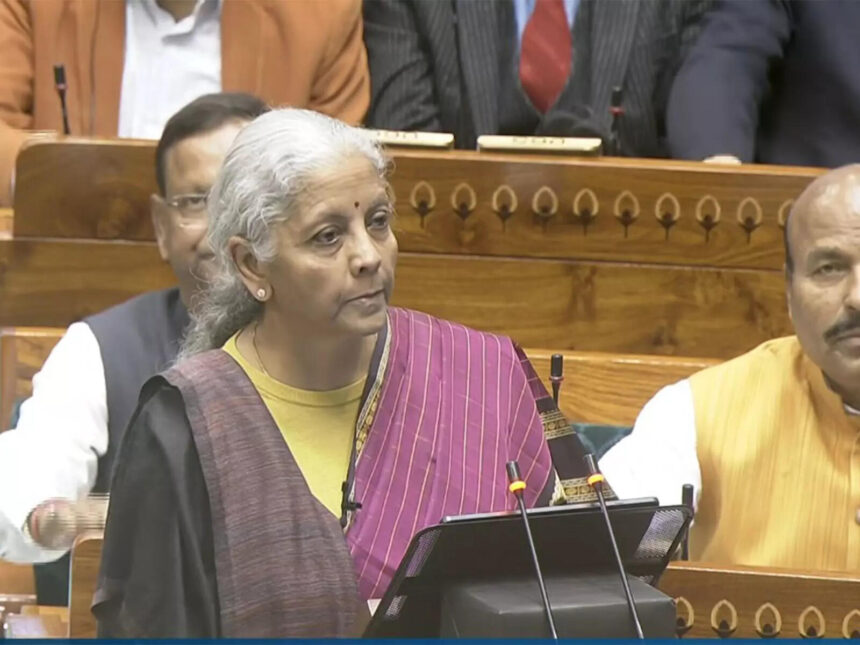
The Minister of Finance presents the budget
Signaling a shift in employment strategy, the budget, rather than announcing the number of jobs to be created, focuses on creating the conditions for sustainable work, with skills, services and sector-led ecosystems emerging as key pillars.
A high-level standing committee on education, employment and enterprise will identify skills gaps, identify high-employment service sub-sectors and assess the impact of AI on future jobs.The services sector has been positioned as a key driver of jobs, with the aim of securing a 10% share of global services exports by 2047. Healthcare also forms a key part of these efforts, with a proposal to add 100,000 professionals over five years.
Recognizing the “orange economy”, which covers animation, visual effects and gaming, the government aims to set up content creation labs in 15,000 secondary schools and 500 colleges.
India reduces its dependence on China; FM Nirmala’s stunning announcement of Rare Earth Corridor in Budget 2026
Service Charges India Needs: Budget takes the degree of skill in paying jobsThe Union Budget signaled a shift in employment generation strategy. Rather than looking for a headline job figure, the government is creating the conditions for sustainable work, with sector-led skills, services and ecosystems as pillars.The government plans to align the demand for education, skills and industry to achieve this goal.
As part of this strategy, a high-level standing committee on education, employment and enterprise will be established. It will identify skills gaps and high-employment service subsectors and assess the impact of AI on jobs. This stems from the realization that degrees alone no longer translate into employability.The services sector has been positioned as the main driver of jobs, with the aim of securing a 10% share of global services exports by 2047.
Services generate more employment per rupee of output than manufacturing, making it key to absorbing the workforce, officials said.Health care services will form a large part of the trend. The budget proposes to add 1,00,000 allied health professionals across 10 specialties over five years apart from training 1.5 lakh caregivers in the next year through aged care and allied care programs aligned with the National Skills Qualifications Framework.Tourism centers of medical value, AYUSH institutions and expanded health infrastructure are expected to create additional jobs in the downstream stages. They will also prepare young people for opportunities that may become available abroad due to the gains the government has made in “mobility” in free trade agreements.A notable addition is the recognition of the Orange Economy – covering animation, visual effects, gaming and comics – as the sector is expected to need two million professionals by 2030.
To build this pipeline, the government will set up content creation labs in 15,000 schools and 500 colleges, signaling a shift towards creative and export-oriented employment.Tourism is being treated as a job multiplier, with plans to establish a national hospitality institute, train 10,000 tour guides in 20 iconic locations, and expand ecotourism, trekking, birding and heritage circuits aimed at generating employment for non-immigrants in small towns and rural areas.Sports as a structured employment ecosystem is also being recast under Khelo India’s expanded mission, covering athletes, coaches, support staff, sports science professionals and infrastructure roles.5 university towns and hostels for girls in all regionsWith a promise to set up girls’ hostels in every district and spend nearly Rs 1.4 lakh crore on education, the Budget signals a clear shift from schemes to structures, putting women’s access and campus capacity at the heart of its educational push.The education ministry’s allocation rose by 8.3% to Rs 1,39,290 crore in 2026-27, with Rs 83,561 crore allocated to school education and literacy (up 6.4%) and Rs 55,724 crore for higher education, an increase of 11.3% aimed at expanding infrastructure and research.One of the major higher education initiatives is the creation of five university towns near major industrial and logistics corridors, designed to cluster universities, colleges and research institutions near emerging economic centres.To improve women’s enrollment and retention rates in science, technology, engineering and engineering, the government will provide capital support to establish at least one girls’ hostel in every district with STEM tertiary institutions, addressing long-standing accommodation gaps.The budget also proposed the establishment of a new National Institute of Design (NID) in the Eastern Province.It has expanded digital learning infrastructure in schools and colleges. It was announced that the Indian Institute of Creative Technologies, Mumbai will support the establishment of AVGC content creation labs. The Bharatiya Bhasha Pustak initiative will roll out digital textbooks in Indian languages for primary and secondary students, with the aim of improving access and understanding in regional languages.In terms of institutional funding, the allocation for Indian Institutes of Technology rises to Rs 12,123 crore and IIMs to Rs 292 crore, while other leading institutes, including IISc and IIITs, see tighter budgets.