

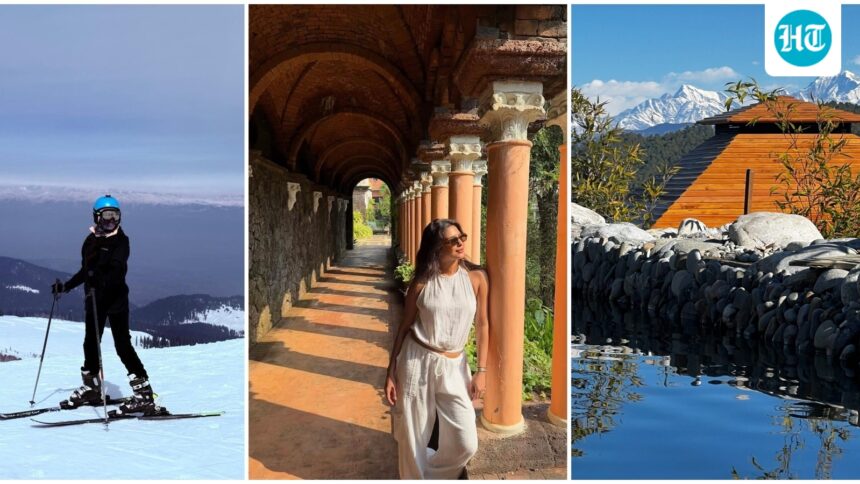
Travel is no longer about big hotels or flashy amenities. Today true luxury is called for.

Somewhere along the way, luxury travel stopped being about infinity pools and sky-high breakfasts. I stopped trying to impress everyone in the room. Instead, he began asking a different question: Who is actually in the room?

Today, luxury is less about excess and more about accessibility. Not just where you stay, but whether you’re allowed to stay there at all.
Algorithm-friendly travel is everywhere. Same attractive villas. Same sunset floors. Same as viral Tablescapes. But the real exclusivity has quietly moved offline. The real resilience now is not the vision. It is a restriction.
The most in-demand stays are those that are difficult to book. Some require you to apply. Some require a referral. Some only share their addresses after they decide you’re the right person.
The portal is an upgrade
Last November, actress Priyanka Chopra Jonas shared glimpses of her stay at Goa’s Aguada Palace, owned by entrepreneur Pinky Reddy, a property that perfectly embodies this new wave of luxury. The ten-suite property is located on a slope and is only fully booked for approx $21 lakh per night.
There is no link to book online and no option for overnight access. The ten-suite house is taken only as a whole, and each application is screened through a detailed questionnaire
A similar philosophy shapes designer Rahul Mishra Atman’s first architectural project in the Himalayas. Located at an altitude of 6,000 feet in Kalakhet village near Nainital, this space serves as his family home and boutique residence.
With just six bedrooms, one of which is dedicated to Mishra himself, it feels less like a residence and more like an invitation into a private world. Stays here are as much about cultural immersion as comfort, including carefully prepared Kumaoni thalis that introduce guests to the flavors and rhythms of the region.
“Aatman is not designed to be walked in, it is designed to be walked in,” says Mishra. “Since it is our family home and remains very personal to us, welcoming a guest is more like an invitation than a reservation.” There is no specific waiting period. Some responses are immediate, others depend on the alignment of dates, intention, and what he calls the rhythm of home.
The house is only open during specific windows throughout the year. Guests can practice yoga, sip morning tea by the pond, or take a walk in the forest where breakfast is served deep in the trees. Afternoons are intentionally unwritten, spent reading, drawing, gardening, or just sitting still. Mishra notes that phones are often forgotten. For him, the right guest understands that luxury today is not abundance, but a calibration of time and space, silence and care. “The rarest luxury now is privacy, intention, and stillness,” he says.
The right room
Sometimes, the true destination is not the landscape, but the people you meet there. The entire secret skating party in Gulmarg is built on this belief. Hosted by Krishan Anand, whose family has welcomed royalty and industrialists for more than a century, the resort offers a deeply personal insight into Kashmir.
“Getting access to the right people, the right events, the right everything,” says Anand. “No one wants something that everyone can be a part of. There is a lot of money in India today, but it’s not about the money. It’s about the right room. It’s about community. It’s about belonging.”
Entry is notoriously difficult. Last year, 212 people applied for just 32 places. Applicants are vetted through their social media presence and personal story to make sure the mix feels right. “Someone at the Mumbai Marathon joked with me that getting into the secret skating party is harder than getting into Harvard, because the acceptance rate is lower,” Anand recalls.
Focus on the chemistry, not the spectacle. Days may include skiing, while evenings end with a 12-course wazoan meal eaten on the grounds alongside first-time artists, founders and strangers. In approx $1.5 lakh per person for four nights and everything is taken care of. What guests remember most are not the slopes, but the conversations.
Find your people
Travel communities like Bucketlist and Beachhouse Project have taken this idea even further. Both were founded on the belief that the future of travel lies in small, intentional groups.
The Beachhouse Project hosts week-long stays in villas across Goa, Ladakh and Bali, designed as mental getaways for founders and creatives. The invitation-only model is central to how these trips work. “It was never about exclusivity per se,” explains founder Jay Ahia. “It was about chemistry. When you get 14 to 18 strangers together for a week, the wrong combination kills the experience. The right combination creates something you can’t manufacture.”
The apps focus on personality and intent rather than titles. Prices range from $80,000 for stays to approx $3 lakh for longer missions.
Live differently
Then there’s Fatalia, which offers an invitation-only abbreviated travel experience in the Solan district of Himachal Pradesh. Spread across 90 acres and with just five rooms, the community resort, run by Aditya Sharma and his wife, prioritizes sustainable living on a large scale. The space also gained wider attention after creator Bhuvan Bam mentioned it.
The application process is intentionally personal. Prospective guests are informed in advance that there is no room service, that meals follow set times, and that the nearest store is half an hour away. It acts as a filter, ensuring alignment before sharing the site.
“The place is about tranquility, experiencing wellness programs rooted in yoga practices, guided forest dives, and exploring the night sky,” says Sharma. “Anyone who spends time here is exposed to a different way of life.” “This shift in perspective is what we aim to create.”

Navya writes about fashion, art and culture for Daily Entertainment and Lifestyle magazine for HT City supplement.
