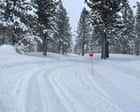
The avalanche that killed at least eight skiers in California’s Sierra Nevada mountains occurred in the Castle Peak area near Lake Tahoe — an area where deadly avalanches are not uncommon.
The Sierra Avalanche Center, which provides forecasts for the region, has observed at least 50 avalanches in the area near Lake Tahoe since September 2025. And according to the National Avalanche Center, which maintains a map of areas with high avalanche danger, the Lake Tahoe area is currently at the highest risk.
As of Wednesday, the region ranked four out of five on the North American Public Avalanche Danger Scale, making it one of the highest avalanche risk areas in the United States at this time.
Avalanches have killed people in the Lake Tahoe area in six of the last 10 years. Most recently, a snowmobiler was killed in an avalanche in the same area near Castle Peak earlier this year.
A backcountry tourer was killed on Powderhouse Peak in February of last year, according to the Colorado Avalanche Information Center.
In January 2024, two riders were caught in an avalanche on KT-22 in the Sierra Nevadas, one killed. And in March of 2021, a snowmobiler died in an avalanche near Frog Lake Cliffs north of Donner Pass.
Other deadly avalanches occurred in the region in 2020, 2018 and 2016.
Perhaps the most famous avalanche in the region was the Alpine Meadows Avalanche of 1982.
That March, a wall of snow collapsed at Alpine Meadows Ski Resort, killing seven people. Although the resort was closed due to the weather, four employees were among the dead. The event is commemorated in the book Buried: The 1982 Alpine Meadows Avalanche and A Wall of White by Jennifer Woodleaf.
Avalanche fatalities are more common in the backcountry than at ski resorts. Last year, the Colorado Avalanche Information Center recorded 19 avalanche deaths across the US in the backcountry during the 2024-2025 ski season.
Although avalanches are not uncommon in the Sierras, Tuesday’s avalanche death toll was one of the worst in US history.
The deadliest avalanche in US history occurred in 1910 in Wellington, Washington, when an avalanche drove two passenger trains into a ravine, killing 96 people. The second deadliest incident occurred in 1898 in Chilkoot, Alaska, when an avalanche killed about 65 people during the Klondike Gold Rush. The third highest death toll from an avalanche occurred in 1981, when an avalanche on the Ingraham Glacier washed away Mount Rainier, killing 10 people.
Tuesday’s avalanche on Castle Peak is now the fourth deadliest in US history.
Avalanche Avalanches can occur when fresh snow falls on an already snowy area.
“When snow falls, it’s a squishy crystalline structure. But as the temperature rises and the snow begins to melt and then freeze, it becomes more granular,” wrote Nathalie Vraind, associate professor of thermofluid sciences at the University of Colorado Boulder, in an article for the Conversation.
“That granular, icy snow is a weak layer. When a new avalanche falls on top of it, the grains in the weak layer are eroded, creating a surface for the avalanche to slide on.”
Tuesday’s snowfall was a “continuous weak layer” of “large snow,” Tahoe National Forest forest supervisor Chris Futrier said at a press conference Wednesday. That weak layer remained and was reloaded with another three feet of snow, he said.