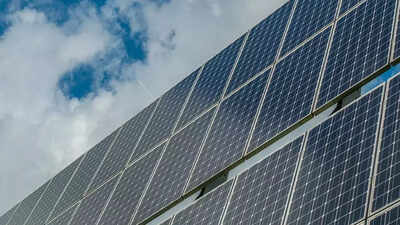
Uttarakhand has achieved a major milestone in renewable energy, crossing 1 GW of installed solar capacity. The state’s total installed solar capacity now stands at more than 1,027.87 megawatts, underscoring its increasing push toward clean and sustainable energy.Prime Minister Pushkar Singh Dhami said the achievement reflects the Centre’s policy focus on renewable energy under the leadership of Prime Minister Narendra Modi. He said the Prime Minister’s vision of Atmanirbhar Bharat and focus on green energy has encouraged states like Uttarakhand to turn solar energy into a people-led movement.According to Dhami, the coordinated implementation of central schemes and state-led initiatives has also opened self-employment opportunities for local youth and entrepreneurs.
He expressed confidence that the state of Uttarakhand will work to strengthen its position among the leading Indian states in the field of solar energy in the coming years.This achievement has been achieved through a combination of grid-connected rooftop solar projects, ground-mounted plants, installations on government buildings, solar pumps for agriculture, and solar schemes for domestic, commercial and industrial consumers.Of the total installed capacity, about 397 MW came from ground-mounted projects, 241 MW from rooftop solar installations under the PM Surya Ghar scheme, 137 MW under the Prime Minister’s Self-Employment Solar Scheme, 110 MW through commercial net metering, 51 MW from captive solar power plants, 37 MW from canal top and canal bank projects, and 26 MW from solar installations in government buildings.
In addition, more than 100 MW are currently being installed under the Prime Minister’s Solar Self-Employment Programme, along with 30 MW from captive solar power plants and 13.5 MW in government buildings. These efforts have contributed to reducing carbon emissions, improving energy self-reliance, and generating local employment opportunities.Uttarakhand Renewable Energy Development Agency (UREDA) has played a key role in driving solar adoption across the state by implementing projects, providing technical support, raising awareness and extending solar solutions to remote and mountainous areas.Supportive policies, subsidies, simplified approval processes and incentives for private investment have helped accelerate the growth of solar energy, officials said. The state government has set other targets to expand solar capacity, deepen connectivity in remote areas, and enhance public engagement as part of its long-term sustainability goals.