
After five hospitals failed to diagnose her with a rare but fatal birth defect, Ameesha Adhia launched a campaign demanding the NHS do more to diagnose the condition and save lives.
If pregnant women have already given birth by caesarean section or had IVF treatment, the risk of developing placenta accreta spectrum is very high.
If the woman is not diagnosed before she goes into labor, she may have to undergo an emergency hysterectomy or risk bleeding due to severe bleeding.
According to the NHS, between one in 300 and one in 2,000 women develop placenta accreta. Doctors are warning that the number of women at risk is rising as more babies are born by C-section (45%) than vaginally (44%) in England.
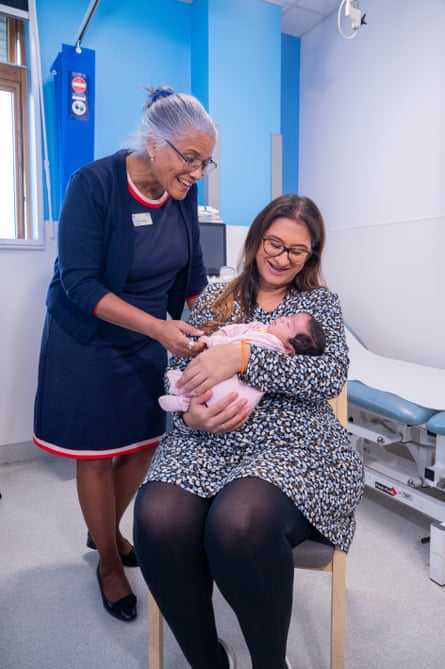
“Placenta accreta can cause catastrophic bleeding within minutes if not anticipated,” said Adhia, who founded the Action for Accreta campaign with her husband Nick. She says she fears women with the condition are not being recognized because too few NHS maternity specialists are correctly diagnosing it, putting women and their babies at serious risk.
Placenta accreta occurs when the placenta, which provides nutrients and oxygen to the fetus, grows too deep into the wall of a woman’s uterus and blocks part or all of the uterus. This makes the normal separation of the placenta from the uterus difficult during childbirth.
Obstetricians at five London hospitals said Adhia’s condition was normal. But Dr Chinese Otigba, a consultant obstetrician, confirmed that she did. Her intervention ensured Adiya, 36, received appropriate care when she gave birth to her daughter Isha last September under the care of a doctor at Queen’s Hospital in Romford, north-east London.
“I am alive today because Dr. Otigba recognized the risk and took action. I was repeatedly told that the risk of placenta accreta was almost zero because my placenta was high instead of low. But it was there and it was very serious.
“I was reassured that I was in danger. I was carrying a condition that could kill us both. I felt unheard. I thought I was going to die.”
Adhia lost about a liter of blood while delivering Ishani by C-section, much less than other births with placenta accreta, but without serious complications. Her experience of being “assessed, downgraded and ignored” by five hospitals, she says, “eliminated” concerns that she had placenta accreta, prompting her and her husband to raise awareness of the condition.
About 40 women who had suffered setbacks during pregnancy or childbirth contacted the couple after seeing their posts on social media because their placenta accreta had gone unrecognized.
There are no figures to indicate how often placenta accreta develops or causes complications as the NHS does not record information. The annual MBBRACE-UK report on maternal health and birth outcomes also lacks detail. Studies from the US and Israel suggest the prevalence may be as high as one in 111 pregnant women.
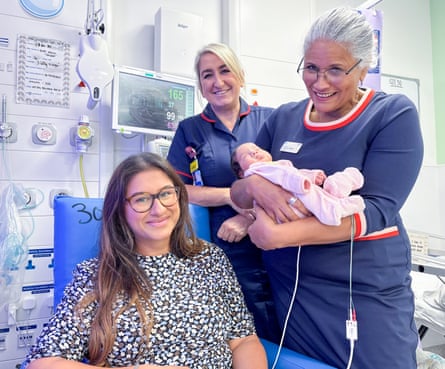
Eight baby and maternal health groups supported the campaign, including Birthrights and the Birth Trauma Association. Separately, baby charities Tommy’s and Sands welcomed it in a joint statement for “helping to highlight important gaps in awareness, surveillance and practice” about serious complications of pregnancy.
Current guidance from the Royal College of Obstetricians and Gynecologists (RCOG), which represents obstetricians, states that placenta accreta and placenta praevia, which can also cause major blood loss, “are associated with high maternal and neonatal morbidity and mortality”. Both rates have increased and will continue to increase as a result of an increase in C-sections, higher average maternal age and increased use of “assisted-reproductive technology,” it added.
The Adias recently gave evidence to the Valerie Amos inquiry into maternity care in England, which was ordered last year by Health Secretary Wes Streeting, who is also the couple’s MP. They asked Amos to include recommendations in her report that the NHS do more to detect placenta accreta.
“I am deeply concerned that women are falling through the cracks in our current system,” says Otigba.
“The main risk factors for PAS are C-sections and IVF, which have increased dramatically. [But] The NHS has not kept up to date with this reality. Not every hospital has a PAS specialist, so subtle warning signs can be ignored.
The couple said they are asking the RCOG, which is updating its guidance, to include advice on diagnosing and managing the specific form of PAS that Amisha has.
An RCOG spokesman said: “Placenta accreta spectrum is a rare but potentially very serious complication of pregnancy where the placenta attaches too deeply to the wall of the womb, causing heavy bleeding and trauma at birth.
“According to current data, it affects between 1 in 300 and 1 in 2,000 pregnancies, although in the UK and worldwide, the incidence is increasing.
“We know that early detection of placenta accreta through prenatal scans and appropriate follow-up imaging is critical so that care can be carefully planned with appropriate specialist teams that improve outcomes for women and babies.”
The updated guidelines are expected to be published later this year, it said.
NHS England did not directly respond to the concerns raised. Its national clinical director for obstetrics, Professor Donald Peebles, said: “The spectrum of placenta accreta is rare, but when it does occur it can cause life-threatening bleeding, which is why it’s important to identify women at high risk early in pregnancy.
“Maternity teams are trained to look out for warning signs, with women who have previously had a caesarean among those most at risk, and where necessary, refer patients to specialist NHS centres.”