
Silicon Valley tech billionaires will descend on Delhi this week for an AI summit hosted by Indian Prime Minister Narendra Modi, where leaders from the global south will wrestle for control of the fastest-growing technology.
The week-long AI Impact Summit will bring together thousands of tech executives, government officials and AI safety experts, leaders of trillion-dollar tech companies and countries like Kenya and Indonesia where average wages are less than $1,000 a month.
Amid the push to accelerate AI adoption globally, Google, OpenAI and Anthropic heads Sundar Pichai, Sam Altman and Dario Amodei will all be there. Rishi Sunak and George Osborne, former British prime minister and former chancellor, are each pushing for greater adoption of AI. Sunak has landed jobs for Microsoft and Anthropic, and Osborne has led OpenAI’s push to deepen and broaden the use of ChatGPT beyond its current 800 million users.
Meanwhile, Modi, who will address the summit on Thursday, has positioned India as an AI hub for South Asia and Africa. The agenda includes the potential of AI to transform agriculture, water supply and public health. The governments of Kenya, Senegal, Mauritius, Togo, Indonesia and Egypt will send ministers.
Civil rights campaigners say Modi’s enthusiasm for AI has a dark side. Last week they raised serious concerns over India’s deployment of AI to increase state surveillance, discriminate against minorities and rig elections. But Modi this week spoke of “using artificial intelligence for human-centric progress,” and India gave the summit a strapline: “Welfare for all, happiness for all.”

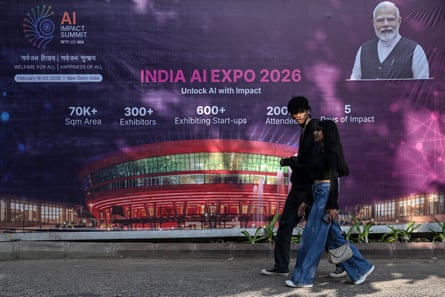
Summit observers spoke of a battle between a new kind of AI colonialism from US tech firms and an alternative “techno-Gandhism” in which AI works for social justice and benefits marginalized people. After global AI summits in the UK, Korea and France, the Delhi conference will be the first in the Global South.
Indian commentators say the test of AI’s value is not in its technological sophistication, but whether it can improve the lives of people living in some of the harshest conditions in the Global South. In contrast, US AI companies are vying for dominance, competing with each other and with China, and are building AI for shopping, personal assistance and agent systems that can reduce corporate labor costs by making white-collar jobs redundant.
If a referee is needed between the two sides, United Nations Secretary-General Antonio Guterres will speak in Delhi. This week he said it is “completely unacceptable that AI is the prerogative of the most developed countries or a division only between two superpowers”.
India’s AI Impact Summit is the fourth iteration of the event, launched by Sunac in 2023 at Bletchley Park, UK, with a focus on international coordination to avert catastrophic risks from the most advanced AI models. At summits in Seoul in 2024 and Paris in 2025, the US Vice President, JD Vance, appeared to dismiss the White House’s interest in security: “The AI future will not be won by fumbling about security; it will be won by building it.”
Security is once again on the agenda with one of the “godfathers” of AI, Yoshua Bengio, ready to repeat his fears about the danger of powerful AI systems launching cyber- and bioweapons attacks.
“While AI’s capabilities continue to advance, and so does AI’s mitigation and risk management. [it has happened] Not so soon,” he said on Tuesday. “So it’s imperative that the leaders of this world understand where we’re going and need their attention and intervention as soon as possible.”
Nicholas Miahle, co-founder of the AI Safety Connect Group, is one of those working on the summit to ensure AI is safe, noting that the summit is taking place in the shadow of AI-enabled warfare in Ukraine and the Middle East.
“The existential risks are not going anywhere,” he told the Guardian. “When Rishi Sunak started it, the race was not so raging. Tr Millions are pouring in, but we are a long way from securing these models. It’s profound for democracy, profound for our children’s mental health, and profound for war.”
But the Trump administration continues its policy of refusing to bind US AI companies with red tape. While the White House is unlikely to send a high-level representative to Delhi, its senior AI policy adviser Sriram Krishnan is the highest-ranking speaker listed at the event.
“Given where we are with the US administration, it’s highly unlikely that you’ll have a huge breakthrough on consensus on what the regulatory framework will look like,” said a senior AI company source.
Companies such as Google are focusing on the use of AI in education in India, where the ability of large language models to work in the country’s several dozen languages is an advantage.
“[There’s] A big focus on access and adoption is how you make sure the technology is as widely available as possible,” said Owen Larter, head of frontier AI policy and public affairs at Google DeepMind. “We’re excited about the education sector in India. This is a great story of extreme adoption. Almost 90% of teachers and students already use AI in their learning. We have a large promotional program where over 2 million students can access our Pro subscription for free.
Google’s investments in India include a $15 billion gigawatt-scale AI datacenter hub off the coast of Visakhapatnam in Andhra Pradesh, with subsea cables connecting it to the rest of the world, in partnership with the conglomerate of one of India’s richest billionaires, Gautam Adani.