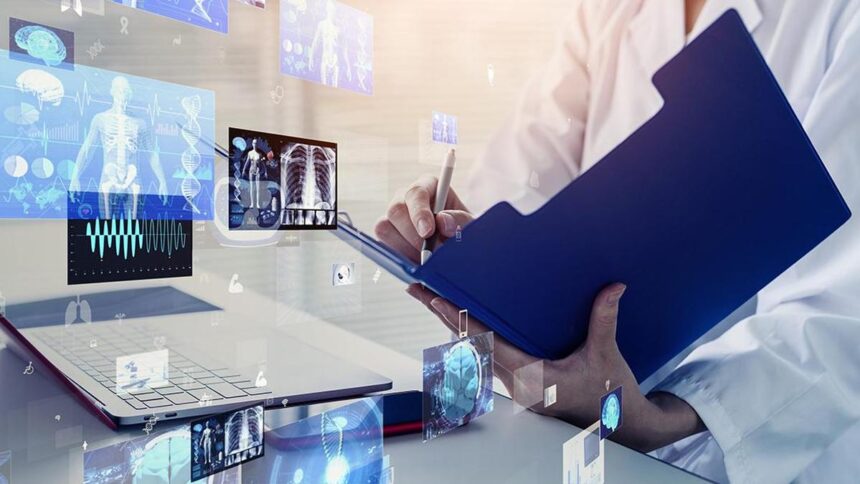
The year was 1997. A senior resident received an urgent call at 11 PM: drive across Miami to retrieve X-ray films for the next day’s surgery. His attending’s message was clear—don’t return without them. So, he climbed into his car and navigated the dark streets, hoping the other hospital’s radiology department hadn’t misplaced the films, that someone would be there to retrieve them, that he wouldn’t be the reason the attending would cancel tomorrow’s surgery. This chaos was routine medicine.

The paper era
Before electronic medical records, hospitals operated like medieval libraries, running on hope and handwriting, with every piece of information existing in exactly one place at any given time. After morning rounds, residents would join queues in radiology, all waiting to view X-rays and CT scans. The films lived in the radiology department. If you wanted to see them, you went there. If the radiologist was using them, you waited.
The charts themselves were archaeological challenges. Physicians’ notes were often illegible scribbles—the infamous “doctor’s handwriting” wasn’t a joke but a genuine patient safety hazard. Critical information about an adverse outcome might be buried on page 47 of a 200-page chart. Previous hospitalisations at other facilities might as well have occurred on another planet.
The evolution
I was in residency when I first encountered the United States Veteran Affairs electronic medical record (EMR) system. It was a good source of data—everything was documented and accessible—but painfully slow and inefficient.
By fellowship, things had improved. The EMR was still slow, but more efficient. You could sense the trajectory—this technology wasn’t just viable, it was inevitable.

The revolution
Today, as I eat my dinner at home, my phone buzzes. A patient in the emergency department has chest pain. I open the app and within seconds I’m looking at their EKG. Anterior ST elevations—this is a heart attack, but the old EKG shows that this is not new. I pull up their chart: previous stent three years ago, allergic to ticagrelor, and creatinine slightly elevated. I review the troponin trend, check the echocardiogram, and I’m on the phone with the ER before my food gets cold.
Fifteen years ago, this would have required a drive to the hospital and, possibly, an unnecessary procedure.
The same technology that lets me work from home also lets me leave work earlier. I complete my procedure notes from home rather than staying late. Complex CT scans that once required a trip to radiology are now available at my fingertips, with the ability to zoom in and obtain additional measurements.
The safety revolution
The most profound impact of EMRs isn’t convenience—it’s safety.
When I order medications, the system immediately flags interactions I might miss at 2 AM. It alerts me that the patient had an adverse reaction to a similar drug at another hospital six months ago. It stops me from prescribing a medication that could harm someone with their kidney function.
These aren’t hypothetical benefits. The World Health Organization notes that medication errors are one of the leading causes of patient harm in health care. Electronic prescribing with clinical decision support prevents thousands of these errors every day.

Beyond individual patients
Electronic records have transformed medicine beyond individual patient care. Quality improvement became possible because we could systematically measure outcomes. Research accelerated because we could analyse thousands of records to identify patterns.
Perhaps most importantly, EMRs gave patients real-time access to their own care and data. Patients can now review their test results, read their doctor’s notes, and track their medications. Sometimes they point out documentation errors—a medication they stopped months ago still listed as active, an allergy that was actually just an intolerance—which we can immediately correct. This patient engagement improves accuracy and safety in ways we never anticipated.
The COVID-19 pandemic demonstrated EMRs’ true power. Hospitals shared treatment protocols instantly. Researchers analysed millions of records to identify risk factors and effective therapies. Telemedicine, built on electronic records, allowed continued care when physical visits were dangerous.

What’s behind and ahead of us
My colleague who drove across Miami for those films isn’t a historical curiosity—he’s a reminder of what we’ve left behind. The hours wasted searching for charts, the preventable medication errors, the duplicate tests due to unavailable previous results, and the physician burnout from administrative tedium.
Electronic medical records aren’t perfect. They need ongoing improvements in usability and interoperability. However, they represent this century’s most significant medical advancement through the quiet revolution of enabling good medicine, safer procedures, and sustainable practices.
We no longer send residents into the night hoping they find the right films. And personally, when I finish seeing my last patient, I can come home, spend time with my family, and complete my documentation, all while relaxing. The future, with AI input supervised by the human eye, will be limitless.
(Dr. Dinesh Arab is Director, Interventional and Structural Cardiology, AdventHealth Daytona Beach and Clinical Assistant Professor of Medicine, Florida State University dinarab@yahoo.com)