

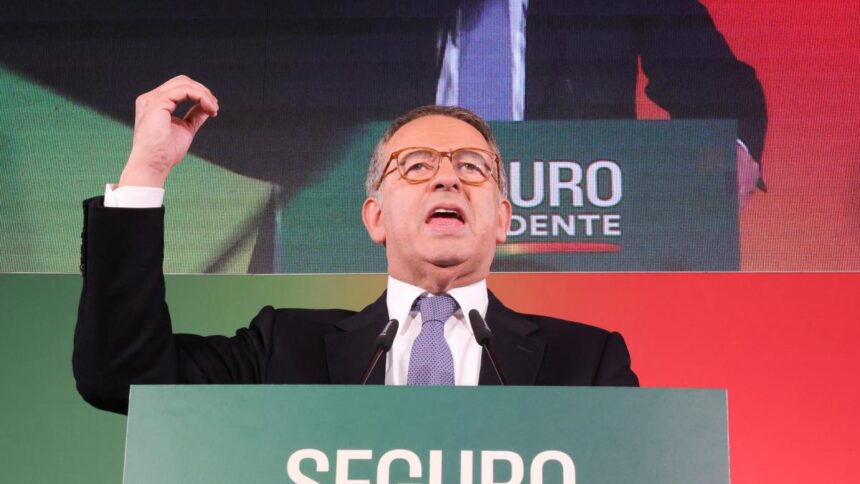

Moderate socialist Antonio José Seguro speaks during his closing ceremony ahead of the February 8 presidential election against far-right leader André Ventura. Image Credit: Reuters
Center-left Socialist candidate Antonio José Seguro is heavily favored to defeat right-wing populist Andre Ventura. of Portugal The presidential election on Sunday (February 8, 2026) will test the depth of support for Ventura’s brash style of politics.
Recent opinion polls show Mr. Ventura getting twice as many votes as Ventura in a showdown between the two leading candidates in last month’s first round of voting. Says Seguro collects, none of the runners captured more than the 50% of the vote needed to win.
But going into the runoff is already a milestone for Ventura and his Chega (Enough) party, which has quickly grown into a significant force in Portuguese politics at a time of a wider European shift to the right.

Mr. Seguro, a longtime socialist politician, has positioned himself as a moderate candidate who would cooperate with Portugal’s center-right minority government, rejecting Ventura’s anti-establishment and anti-immigration undertones.
In Portugal, the president is mostly a person with no executive powers. Traditionally, heads of state stand above the political fray, mediate disputes and defuse tensions.
However, the President is an influential voice and has some powerful tools, being able to veto legislation by Parliament, although vetoes can be overridden. The head of state, known as the “nuclear bomb” in Portuguese political jargon, has the power to dissolve parliament and call early elections.
Also Read | Portugal is headed for another minority government after the general election
In May, Portugal held its third general election in three years amid the country’s worst bout of political instability in decades, and steadying the ship will be a key challenge for the next president.
Ventura, an eloquent and dramatic politician, rejected political accommodation in favor of a more combative stance. One of his main targets is what he calls excessive immigration, as foreign workers have become more prominent in Portugal in recent years.
“Portugal is ours,” he said. During the campaign, Ventura put up billboards across the country saying “This is not Bangladesh” and “Immigrants should not be allowed to live on welfare”. Although he founded his party seven years ago, its surge in public support made it the second largest party in Portugal’s parliament in the May 18 general election.
In March, the winner will replace center-right President Marcelo Rebelo de Sousa, who has served two five-year term limits.
Published – February 08, 2026 12:38 pm IST
![aamir-khan-takes-a-hard-fall-during-a-pickleball-match-at-wpbl-2026-in-mumbai;-fans-are-in-shock-after-he…-[viral-video]-|-bollywood-life](https://globalindiabroadcastnews.com/wp-content/uploads/2026/02/14982-aamir-khan-takes-a-hard-fall-during-a-pickleball-match-at-wpbl-2026-in-mumbai-fans-are-in-6988a76f54e94-150x150. "aamir-khan-takes-a-hard-fall-during-a-pickleball-match-at-wpbl-2026-in-mumbai-fans-are-in-shock-after-he-viral-video-|-bollywood-life | GIBN")