India will not open its markets to US soybeans, corn, meat and dairy products, the biggest imports of which could hurt the country’s farmers, while deepening exchanges between agricultural items the country does not grow enough of, Union Commerce Minister Piyush Goyal said on Saturday.
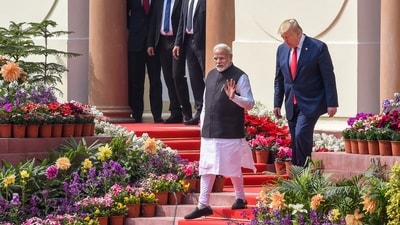
The US and India joint statement on the framework for an interim trade agreement said New Delhi would “eliminate or reduce” tariffs on a “broad range” of agricultural products. (PTI/File Photo)The US and India joint statement on the framework for an interim trade agreement said New Delhi would “eliminate or reduce” tariffs on a “broad range” of agricultural products.
India will grant access to American distillers’ dried grain solubles (DDGS)–a nutrient-rich poultry feed derived from ethanol residues–soybean oil, red sorghum for animal feed, tree nuts, fresh and processed fruits, wine and spirits, according to the joint statement. The framework mentions “surplus products” in agriculture, but does not specify them.
Also Read | Agriculture, dairy sector ‘fully’ protected under India-US trade deal, Piyush Goyal tells Parliament
A trade deal, based on the framework that could be firmed up soon, would protect farmers’ interests by “fully protecting sensitive agriculture and dairy products”, Goyal said at a press briefing.
More Read

India will import products that are not adequately produced domestically while there will be zero US tariffs on many agricultural products, which will benefit domestic farmers, the minister announced. These include Indian spices, tea, coffee, copra, erica, cashew, chestnut, certain fruits and vegetables, avocado, banana, guava, mango, papaya and pineapple, the minister said.
Overall, the 18% tariff, down from the punitive rate of 50%, will boost exports of seafood, rice, honey and processed foods. The US is the largest market for Indian seafood and accounts for 36% of total seafood exports. India exports seafood worth $2.78 billion in 2024-25.
Goyal said there would be “no exemption” on genetically modified or GM products, meat, soybeans, dairy, corn and grains, a key concern among Indian producers. Soy and corn, the two largest US farm exports, are dominated by GM crops.
More Read

Also Read | 18% tariff, $500 billion investment and technology boost 10 takeaways from the India-US trade deal
Experts say the agriculture component of the trade deal still needs clarity on key issues, including GM foods. Although soybean oil will be imported, Goyal says when the crop is processed, the GM effect no longer exists. Besides, there will be an import quota for soybean oil, the minister said.
“We needed a very clear statement on agriculture, like in the EU-India free trade agreement. On these issues, what is ultimately put on paper matters. The joint statement is not very clear,” said Biswajit Dhar, a trade economist and former Indian negotiator at the WTO.
The interim framework said India “agreed to resolve long-standing non-tariff barriers to trade in US food and agricultural products”.
Also Read | What does trade deal with US mean for India? Key points for Delhi in details so far
According to Dhar, India’s ban on importing GM products could possibly be taken as a “non-tariff barrier” to agriculture. “Removal of non-tariff barriers mentioned in the joint statement may be a codeword for GM, although there are other types of barriers,” said Kiran Kumar Visa of Raithu Swaraj Vedika, an anti-GM advocacy group.
More Read

India will open import quotas for extra-long staple cotton and India’s apple growers will be protected with a higher minimum import price, Goyal said.
“Both of those things (cotton and apples) still have a lot of imports today. In cotton, we import a lot of extra long-staple varieties grown in America because we grow so little of that variety. We opened quotas on cotton. For apples, which are imported today, America is given a lower quota than that, and at a tariff rate.”