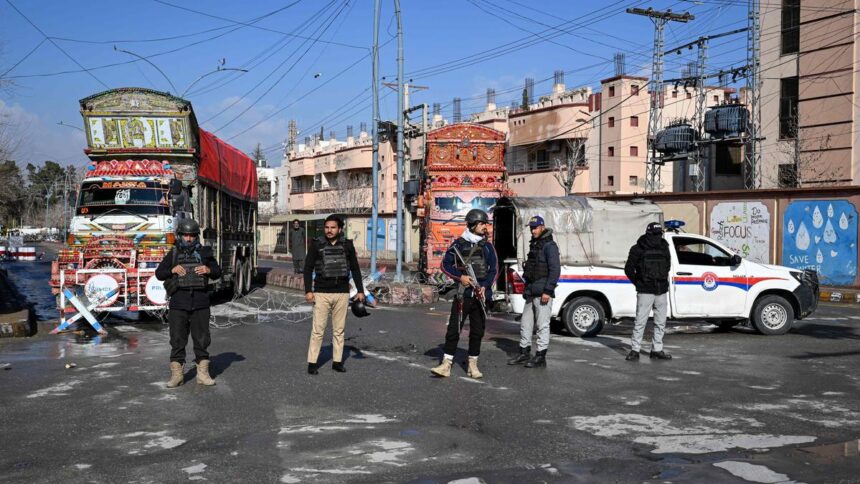

Security personnel cordon off a road leading to the site of an explosion in Quetta on February 1, 2026, a day after an attack by Baloch separatists. | Image Credit: AFP
Pakistani security forces have killed 145 militants over 40 hours after coordinated attacks across Balochistan, the chief minister of the southwestern province said on Sunday (Feb 1, 2026), as authorities grappled with one of the deadliest outbreaks in years.
The attacks underscore the persistence of insurgency in the resource-rich province, which borders Iran and Afghanistan, where separatist militant groups have stepped up attacks on security forces, civilians and infrastructure.
The death toll includes militants killed in the attacks on Friday (January 30, 2026) and Saturday (January 31, 2026) and additional militants killed during ongoing clearance operations, Balochistan Chief Minister Sarfaraz Bugti told a press conference in Quetta.

On Saturday (January 31, 2026), the army claimed that 92 militants were killed.
The latest total is the highest number of militants killed in such a short period since the insurgency intensified, Mr. Bugti said, without providing comparative figures.
He said 17 law enforcement personnel and 31 civilians were killed in the attack.
Balochistan, Pakistan’s largest and poorest province, has faced a decades-long insurgency led by ethnic Baloch separatists seeking greater autonomy and a greater share of its natural resources.
Banned separatist group Baloch Liberation Army claimed responsibility for the attack, saying it had launched a coordinated operation known as Herof or “Black Storm” targeting security forces across the province.
Pakistan’s military on Saturday (Jan 31, 2026) said the attacks were carried out by “India-sponsored militants”. Pakistan’s arch-rival India, on Sunday, denied that assertion, accusing Islamabad of diverting attention from its internal problems.
“We categorically reject the baseless allegations made by Pakistan,” MEA spokesman Randhir Jaiswal said in a statement, adding that Islamabad should instead address the “longstanding demands of its people in the region”.
Violence erupted simultaneously in several districts, including Quetta, Gwadar, Mastung and Noshki, prompting large-scale operations by the army, police and counter-terrorism units. Hospitals in some areas have been placed on emergency basis.
The military said the security forces had repulsed any attempt by the militants to seize control of any city or strategic installation.
Pakistan faces periodic attacks from Islamist militants elsewhere in the country, including factions linked to the Pakistani Taliban.
Published – February 01, 2026 04:31 pm IST